
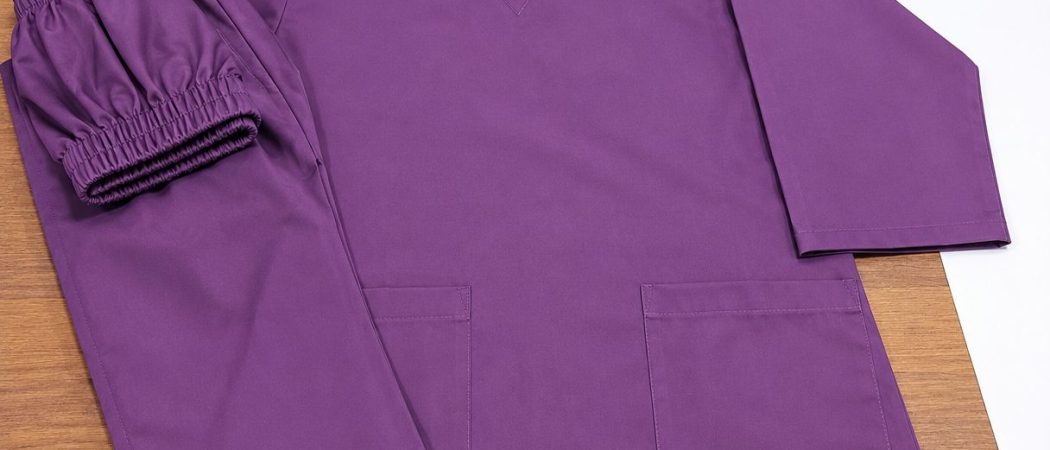
Nurse uniform designs for female and male nurses in Pakistan, with colours, fabrics and modest options.
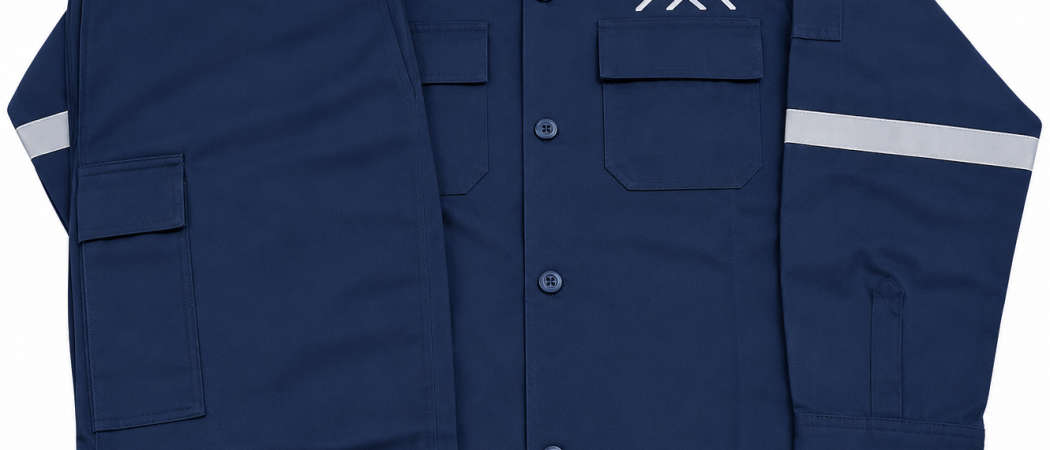
Mechanic Uniform Guide: What Workshop and Garage Staff Should Wear
Coveralls vs shirt-and-trouser sets for mechanics, with fabrics, colours that hide grease and the details workshops need.
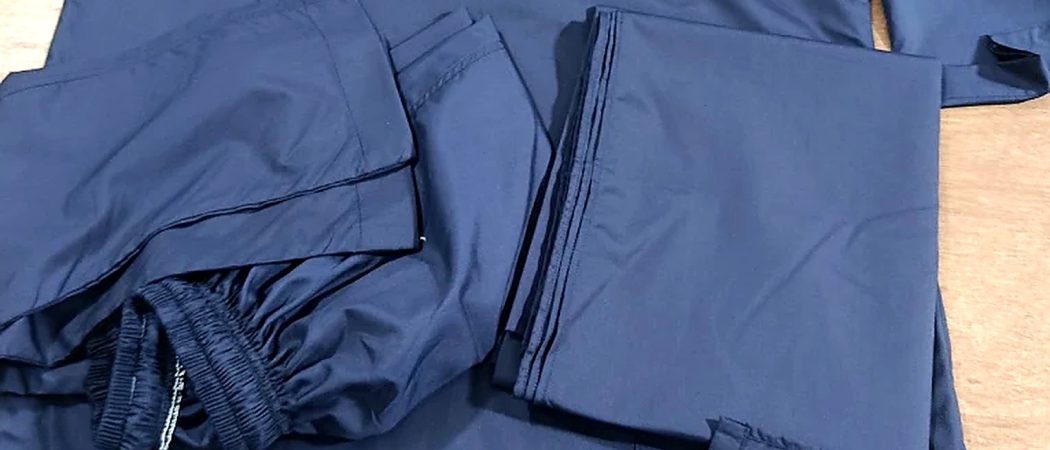
Hospital Staff Uniforms: What Every Role Wears, Ward Boys to Reception
Hospital staff uniforms by role, with a colour-coding plan and fabrics for ward boys, cleaners, reception, guards and kitchen staff.
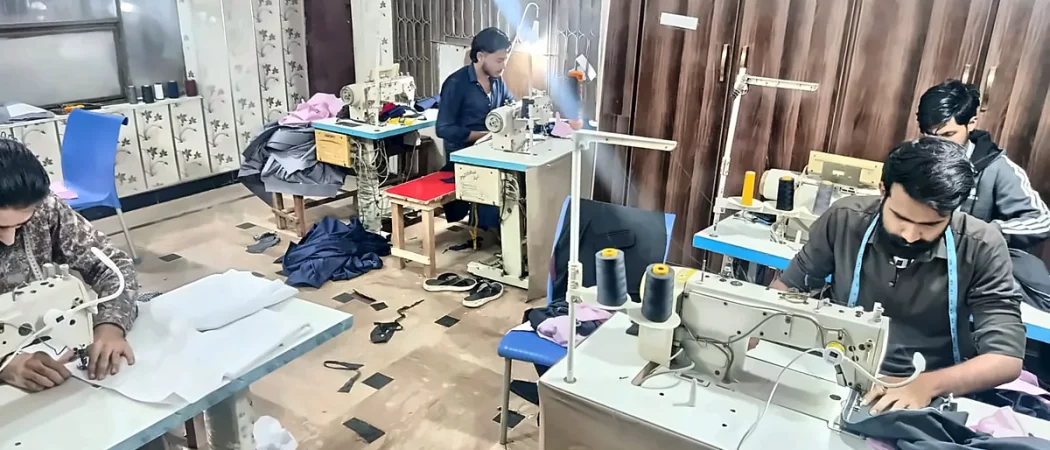
College Uniform Designs in Pakistan
A college uniform must work for students aged 16 to 22 in classrooms, science labs, and long van rides, through a Rawalpindi summer and a Pothohar winter. It also has to look clearly older and more formal than the school uniform students have just left.
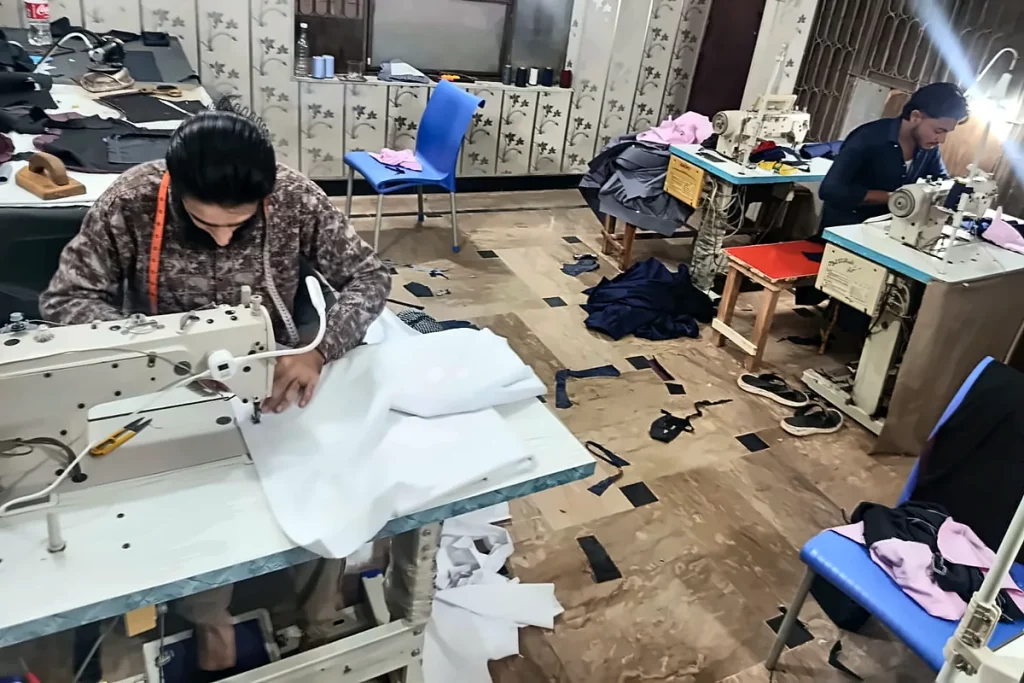
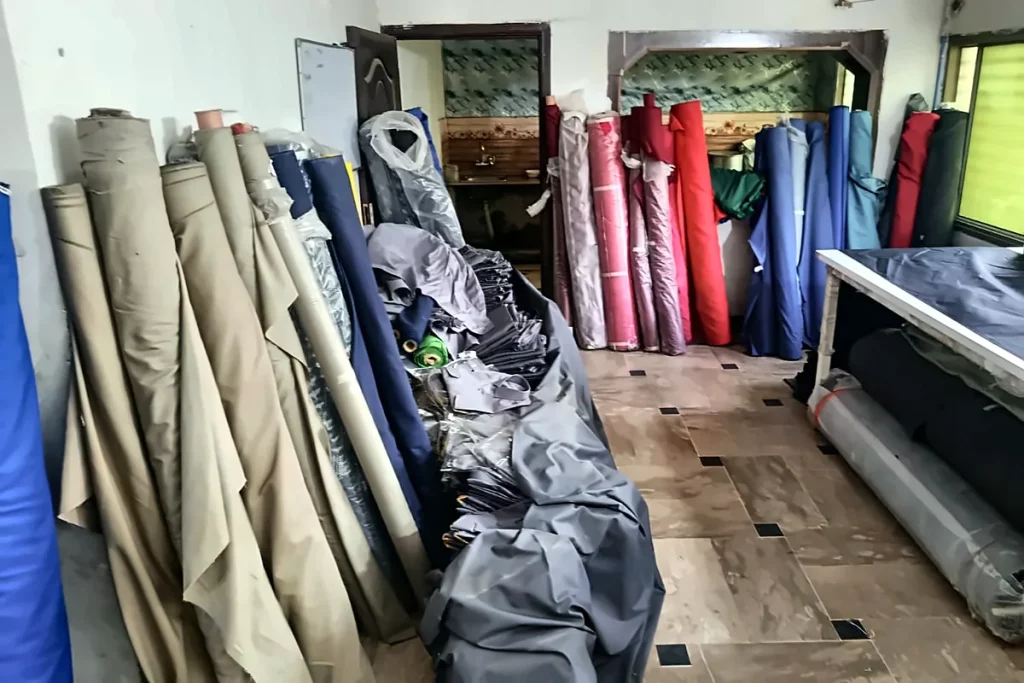
Below are the college uniform designs we make most often at our factory in Rawalpindi, for boys and girls, summer and winter, with fabrics and colours that last two years of daily wear. If you are planning uniforms for a whole college, see how we work as school uniform manufacturers in Pakistan.
How college uniforms differ from school uniforms
College students are young adults, so the uniform moves closer to office wear. The usual differences:
- More formal pieces: blazers instead of jumpers, ties for boys, and plainer colours with no checks.
- Adult sizing: proper chest and waist sizes up to XXL, with slimmer cuts than school sets.
- Course-specific items: white lab coats for FSc pre-medical and pre-engineering students, and tracksuits for sports.
- One look, small differences: many colleges keep one design for intermediate classes (FSc, ICS, ICom, FA) and change only the tie or badge colour for BS students.
College uniform designs for boys
Three designs cover almost every boys’ college we supply:
- Shirt and trousers: a white or sky-blue shirt with grey or navy trousers. The everyday choice, easy to replace mid-year.
- Shirt, trousers and blazer: a navy, maroon or bottle-green blazer with the college crest on the chest pocket, worn on formal days and through winter.
- Shalwar kameez with waistcoat: white or light grey, used by some public and religious colleges.
The details make it look like a college uniform rather than a school one: an embroidered monogram above the shirt pocket, a tie in the college colours, a black belt, and a shirt collar that keeps its shape after washing.
College uniform designs for girls
Girls’ college uniforms in Pakistan are built around the kameez and dupatta, in three main styles:
- Kameez, shalwar and dupatta: a white or sky-blue kameez with a white shalwar and a dupatta in white or the college colour. The most common design.
- Kameez, straight trousers and dupatta: the same kameez with cigarette-style trousers, for a more modern look.
- Coat-style overall: a long navy, grey or black overall worn over the kameez, which keeps the uniform clean and is easy to wash.
The dupatta is where colleges most often have trouble with shade matching between batches. We dye dupattas against your approved swatch and keep that swatch on file, so a girl who joins in the second year matches her class.
Winter college uniforms: blazers and sweaters
Rawalpindi and Islamabad winters are cold enough from December to February that most colleges add a blazer, a sweater or both.
- Blazers: lined poly-viscose or wool-blend suiting, with the crest embroidered on the pocket. Navy, maroon, black and bottle green are the usual colours.
- Sweaters: V-neck knit in the college colour, often with one or two stripes at the neck and cuffs.
- Cardigans for girls: a buttoned knit worn over the kameez, sometimes instead of a blazer.
Order winter pieces by September or October. Blazers take the longest to cut and finish, and factories get busiest once the weather turns cold.
Colour combinations that work
| Shirt or kameez | Trousers or shalwar | Blazer or sweater | Look |
|---|---|---|---|
| White | Grey | Navy | Classic and formal |
| Sky blue | Navy | Navy | Hides daily wear well |
| White | Black | Maroon | Smart for formal events |
| White | White shalwar | Bottle green | Traditional girls’ college look |
| Light grey | Charcoal | Black | Modern and plain |
Pick one main colour and one accent, then use the accent only on the tie, dupatta border, or blazer piping. Fewer colours look smarter and cost less to keep consistent.
Fabric guide for college uniforms
| Item | Fabric | Typical weight | Why |
|---|---|---|---|
| Shirts | 65/35 poly-cotton wash-and-wear | 110–130 GSM | Dries fast and needs little ironing |
| Kameez | Poly-cotton or cotton lawn | 100–120 GSM | Cool enough for summer |
| Trousers and shalwar | Poly-viscose gabardine | 220–260 GSM | Holds a crease and resists shine |
| Blazers | Poly-viscose or wool-blend suiting | 280–320 GSM | Keeps its shape all winter |
| Dupattas | Cotton voile, chiffon or georgette | 40–80 GSM | Light and easy to colour-match |
| Lab coats | Poly-cotton twill | 150–180 GSM | Takes hot washing and lab stains |
These are typical weights; we confirm the exact fabric with a swatch before cutting. For science departments, we also make lab coats in the same white as hospital coats.
Crest, monogram and name tags
College branding is done by computerised embroidery, which outlasts printing on blazers and shirts. The usual placements are the crest on the blazer pocket, a small monogram above the shirt pocket, and the college name on the tie.
For sports teams, we make tracksuits and sports kits in the college colours, and for events, printed T-shirts with the college logo.
How to order college uniforms in Rawalpindi and Islamabad
- Count students by class and size, then add about 10% for new admissions and replacements.
- Fix the design and colours. Bring your current uniform if you want to keep the look.
- See fabric swatches at our uniform factory in Rawalpindi near I-10, IJP Road, or meet our uniform suppliers team in Islamabad at the Blue Area office.
- Approve one sample set with the crest embroidered.
- We stitch the full order from 50 sets and keep your shade and size chart on file, so every new session matches the last. We deliver to colleges across the twin cities and anywhere in Pakistan.
Order six to eight weeks before the new session starts. If you are comparing suppliers, our checklist on how to choose a uniform manufacturer covers the questions to ask.
Frequently asked questions
What colours are common for college uniforms in Pakistan?
Boys usually wear a white or sky-blue shirt with grey or navy trousers. Girls usually wear a white or sky-blue kameez with a white shalwar and a dupatta. Navy, maroon and bottle-green blazers are common in winter.
What is the difference between school and college uniforms?
College uniforms are more formal, with blazers, ties, and plainer colours. They use adult sizes, and science students often add a white lab coat.
Which fabric is best for college uniforms in summer?
65/35 poly-cotton wash-and-wear at 110–130 GSM works best for shirts and kameez. It breathes, dries quickly, and needs little ironing.
What is the minimum order for college uniforms?
Saad Enterprises makes college uniforms from 50 sets. Send your student numbers on WhatsApp, and we will prepare a sample set first.
Planning new uniforms for your college?
WhatsApp +92 331 5050974 with your student numbers and a photo of your current uniform, or visit our factory near I-10, IJP Road, Rawalpindi, to see fabrics and blazer samples. You can also browse all the uniforms we make.
Related guides
Hotel Staff Uniform Designs
A guest meets five or six of your staff before reaching the room: the doorman, the front desk, a bellboy, housekeeping, the restaurant team. What they wear is the first sign that the hotel is well run. More layouts and fabric choices are in our housekeeping uniform designs guide.
Below are the hotel staff uniform designs we make most often at our factory in Rawalpindi, role by role, with the fabrics and colours that last through daily wear and hot washing. If you are planning a full set for your team, our page for hotel uniform suppliers covers ordering, minimums and samples.
Front desk and receptionist uniforms
The front desk is the most photographed team in any hotel, so it gets the most formal look. The three designs hotels choose most:
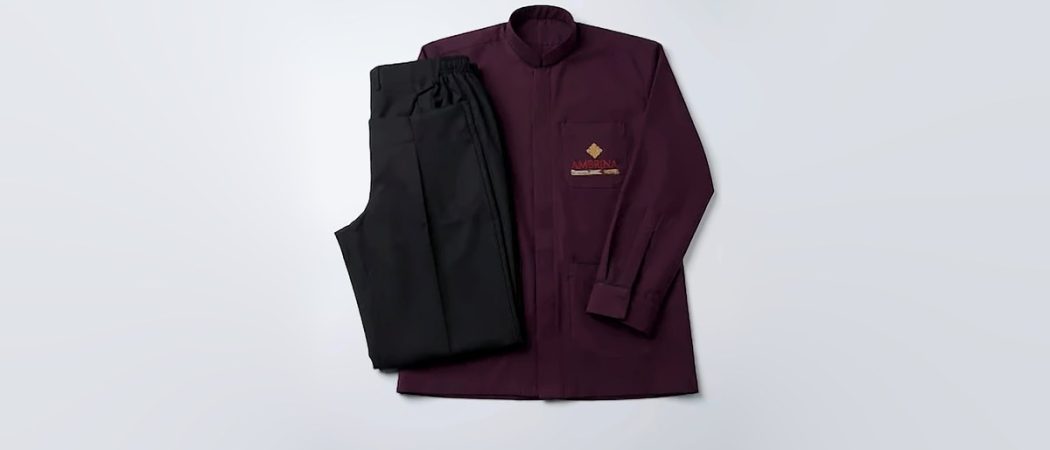
- Blazer, shirt and trousers: a navy, charcoal or black blazer with the hotel logo embroidered on the chest pocket. The safest choice for city hotels.
- Waistcoat, shirt and trousers: lighter and cooler than a blazer, good for lobbies without strong air conditioning.
- Kameez with dupatta for female staff: in the hotel’s colours, with a fitted cut and the logo on the chest. Many Pakistani hotels pair this with blazers for male staff.
Small details make a receptionist look finished: an engraved name badge, a tie or scarf in the accent colour, and a shirt collar that keeps its shape after washing.
Management and duty manager uniforms
Managers should be easy for guests to find. Most hotels dress them in a darker or plainer suit than the front desk, usually charcoal or navy, with a different tie or pocket square.
Suits need to be cut to each person’s measurements, not picked from S, M and L. Our staff suits and blazers are made to measure for exactly this reason.
Housekeeping uniform designs
Housekeeping staff bend, lift and carry chemicals all day, so the design has to move with them. The usual set is a tunic with side or front buttons, trousers with an elastic back, and an apron or waist pouch for keys and cards.
Pick mid-tone or dark colours: grey, maroon, teal or navy hide marks far better than white or cream. For the full range, see our housekeeping staff uniforms.
Restaurant and room service staff
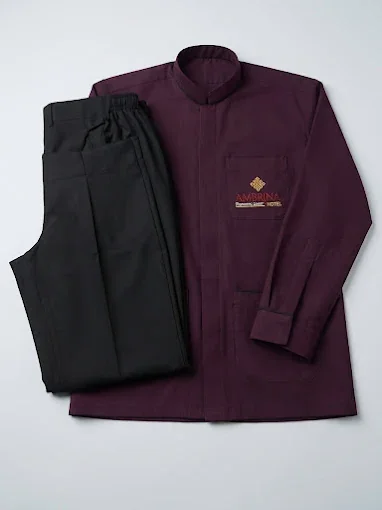
The hotel restaurant usually follows the same palette as the lobby but in a more practical cut. Waiters wear a waistcoat, shirt, trousers and a bistro or bib apron. Fine dining adds a bow tie.
The kitchen stays in chef coats, white for most hotels or black for open kitchens. See our waiter uniforms and chef coats, or browse more looks in our waiter uniform ideas. For every restaurant role in one place, read our role-by-role guide to restaurant staff uniforms.
Doorman and bell staff
The doorman is the first uniform a guest sees, so many hotels give this role the most distinctive design: a longer coat or jacket with contrast piping, a cap, and gloves for formal properties. Bell staff wear a shorter version of the same jacket so the two roles look related. Hotel guards usually wear their own kit; see our security uniforms.
Fabric guide by role
The right fabric depends on how often the garment is washed and how much it has to hold its shape.
| Role | Fabric | Typical weight | Why |
|---|---|---|---|
| Front desk shirts | 65/35 poly-cotton poplin | 110–130 GSM | Crisp, irons easily, does not crease fast |
| Blazers and suits | Poly-viscose suiting | 220–280 GSM | Holds its shape through a full shift |
| Housekeeping tunics | Poly-cotton twill | 160–200 GSM | Survives hot washes and hides stains |
| Waiter waistcoats | Poly-viscose or poly-cotton gabardine | 200–250 GSM | Structured look, wipes clean |
| Chef coats | Poly-cotton twill or cotton drill | 180–220 GSM | Handles heat and daily washing |
These are typical weights. We confirm the exact fabric with a swatch before cutting. For more on kitchen and restaurant fabrics, read our guide to the best fabric for chef coats and restaurant uniforms.
One colour palette across departments
The best-looking hotels use two brand colours and one neutral across every team, then change the shade or the garment by department:
- Front desk and management: the darkest, most formal shade of the palette.
- Restaurant: the same colours, with aprons and waistcoats in the accent colour.
- Housekeeping: a mid-tone that hides marks.
- Kitchen: white or black chef coats, with the accent colour on piping or buttons.
This keeps the hotel looking consistent, and it lets guests and managers tell roles apart at a glance.
How to order hotel staff uniforms
- List every role and its headcount, then add about 10% for new joiners and replacements.
- Choose a design for each role from the options above.
- See fabric swatches at our uniform factory in Rawalpindi near I-10, IJP Road, or meet our uniform suppliers team in Islamabad at the Blue Area office.
- Send a size list, or ask our team to take measurements at your hotel in Rawalpindi or Islamabad.
- Approve one sample set, then we stitch the full order with your logo embroidered in-house. Orders start from 50 sets, and we deliver anywhere in Pakistan.
Frequently asked questions
What should hotel front desk staff wear?
Most hotels dress front desk staff in a blazer or waistcoat over a shirt, with trousers or a kameez and dupatta for female staff. Dark colours like navy or charcoal look formal and hide wear.
What colours are best for hotel housekeeping uniforms?
Mid-tone or dark colours such as grey, maroon, teal or navy. They hide stains from cleaning work far better than white or cream.
How many uniform sets does each hotel staff member need?
Three sets per person is the usual minimum: one worn, one in the wash and one spare. Kitchen staff often need four or five because chef coats are changed daily.
What is the minimum order for hotel staff uniforms?
Saad Enterprises makes hotel uniforms from 50 sets. Send your roles and headcount on WhatsApp and we will confirm how the order can be split across designs.
Planning new uniforms for your hotel?
WhatsApp +92 331 5050974 with your roles and headcount, or visit our factory near I-10, IJP Road, Rawalpindi to see fabrics and sample sets. You can also browse all the uniforms we make.
Related guides
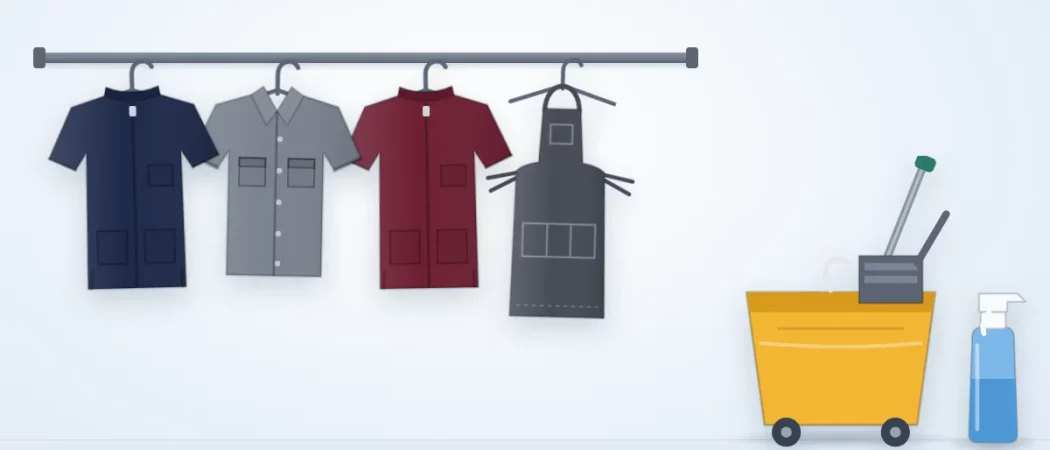
Janitorial Uniforms: What Cleaning Staff Should Wear?
Cleaning staff wear out uniforms faster than almost anyone else on a payroll: bleach spots, wet knees, torn pockets and faded shirts within a few months. Good janitorial uniforms solve that with a simple kit: a tunic or work shirt, durable trousers, an apron for wet work, and closed, slip-resistant shoes, all in a dark, easy-wash poly-cotton fabric.
This guide covers what janitors, cleaners and sweepers should wear, which fabrics and colours last, what changes from a hospital to a hotel to an outdoor sweeping crew, the safety gear that goes with the uniform, and how to order in bulk. We make housekeeping and janitorial uniforms in Rawalpindi, so the advice comes from the orders we stitch for cleaning teams across the twin cities.
What do janitors and cleaning staff wear?
Janitors and cleaning staff usually wear a tunic or work shirt, durable trousers and an apron, with closed, slip-resistant shoes and gloves for chemicals. The exact kit depends on where they clean, but the core pieces stay the same.
| Item | Why cleaning staff need it | What to look for |
|---|---|---|
| Tunic or work shirt | Main uniform piece; carries the logo | Poly-cotton, side vents, 2–3 pockets, half or full sleeves |
| Polo shirt | Smarter look for offices, banks and malls | Pique knit that holds its collar after washing |
| Trousers | Bending and kneeling all shift | Elastic or half-elastic waist, reinforced knees, deep pockets |
| Apron or smock | Keeps splashes and dirt off the uniform | Bib apron with pockets; waterproof apron for washrooms |
| Coverall | Heavy cleaning, maintenance, outdoor work | Twill fabric, full-length zip or buttons, tool pockets |
| Jacket or jersey | Winter shifts and cold storage areas | Same colour as the uniform, logo on the chest |
| Cap or headscarf | Hair control and a neat look | Washable cotton twill, adjustable strap |
| Footwear and gloves | Wet floors and cleaning chemicals | Closed, slip-resistant soles; rubber or nitrile gloves |
Types of janitorial uniforms
The main types of janitorial uniforms are tunics, work shirts and polos, trousers, aprons, coveralls and winter layers. Most cleaning teams need two or three of these, chosen by how dirty and physical the work gets.
Tunics
A tunic is the most common janitorial uniform top. It is a loose, hip-length top, usually zipped or buttoned at the front, with side vents so staff can bend and stretch freely. Tunics suit hospital, hotel and office cleaners because they look tidy and wash well. In Pakistan, many female cleaning staff prefer a longer, kameez-style tunic over trousers, so it helps to offer both lengths.
Work shirts and polo shirts
Work shirts with a collar and chest pockets suit general janitorial staff, caretakers and maintenance helpers. Polo shirts give a smarter look for front-facing cleaners in offices, banks and shopping malls, where staff work around customers all day. Both carry an embroidered logo well.
Trousers
Janitorial trousers need to survive kneeling, bending and constant washing. Look for an elastic or half-elastic waist, reinforced knees and deep side or cargo pockets for keys and cloths. Match the trouser colour to the top, or use a darker trouser that hides floor dirt.
Aprons and smocks
Aprons are the cheapest way to protect a uniform. A bib apron with front pockets keeps sprays, cloths and small tools at hand, while a waterproof PVC apron is better for washrooms and dishwashing areas. A smock, a short coat worn over clothes, is a good option for part-time or contract cleaners who don’t get a full uniform.
Coveralls
Coveralls suit heavy cleaning: warehouse floors, car parks, waste rooms and outdoor work. They cover the whole body and protect clothes underneath from grease and dirt. See our coverall uniforms for cotton and industrial options.
Jackets, jerseys and caps
Winter shifts in Rawalpindi and Islamabad run cold, especially for early-morning cleaners. A jacket or jersey in the uniform colour keeps the team looking uniform instead of mixing personal sweaters with work clothes. A cotton cap or headscarf completes the kit and keeps hair tidy in food and healthcare areas.
Best fabric and colours for janitorial uniforms
The best fabric for janitorial uniforms is a poly-cotton blend of about 150–220 GSM, in a dark or mid-tone colour such as navy, charcoal grey or maroon. That combination survives daily washing, dries fast and hides the dirt that cleaning work leaves behind.
Which fabric lasts longest?
| Fabric | Typical weight | Best for | Trade-off |
|---|---|---|---|
| Poly-cotton blend (65/35) | 150–220 GSM | Tunics, shirts and trousers for daily cleaning | Slightly less breathable than pure cotton |
| 100% cotton | 150–200 GSM | Hot, humid areas and staff who sweat heavily | Shrinks, fades and wrinkles faster |
| Cotton or poly-cotton twill | 200–280 GSM | Coveralls, heavy trousers, outdoor crews | Heavier and warmer in summer |
| PVC or coated fabric | Not measured in GSM | Waterproof aprons for washrooms and wet work | Not breathable, so worn over the uniform only |
GSM (grams per square metre) measures fabric weight. A heavier fabric lasts longer but feels hotter, which matters in a Rawalpindi summer. For coveralls specifically, our guide to cotton, twill or poly-cotton compares the options in more detail.
Two extras are worth asking for on janitorial fabric:
- Stain-release or soil-release finish, so dirt and grease wash out instead of setting into the weave.
- Good colourfastness, so the colour survives repeated washing. Suppliers can test this to ISO 105-C06, the standard for colour fastness to domestic and commercial laundering.
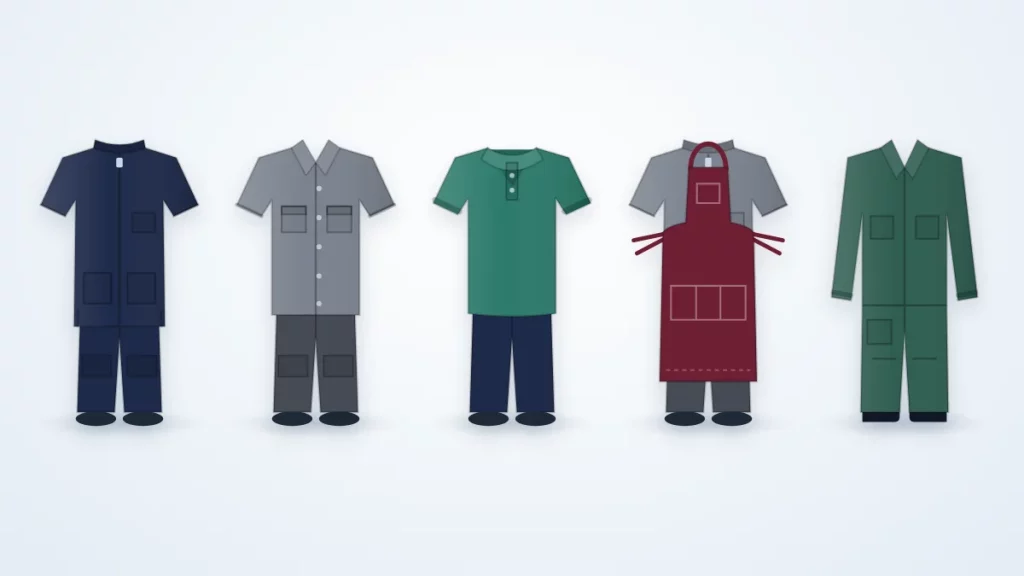
What colour should janitorial uniforms be?
Janitorial uniforms work best in dark or mid-tone colours, because cleaning staff spend the day around dust, water and chemicals.
- Navy and charcoal grey hide dirt and look professional in offices and hotels.
- Maroon and dark green hide stains well and stand out from other staff teams.
- Light blue or teal suit hospitals, where cleaners often wear the same tunic style as clinical support staff.
- Hi-vis yellow or orange is for outdoor crews near traffic; see the sweepers section below.
Avoid white and very pale colours for cleaning teams; every mark shows straight away.
One trade-off buyers often miss: staff who use bleach every day get pale spots on navy and black. For those teams, a mid-grey uniform, a printed tunic or a bib apron over the uniform hides bleach marks far better.
How to wash janitorial uniforms
- Wash after every shift, inside out, in warm water.
- Keep chlorine bleach off coloured uniforms; it fades the dye and weakens the fibres.
- Wash aprons and coveralls separately from tunics if they carry grease or chemicals.
- Line-dry in the shade where possible; strong sun fades dark colours.
Janitorial uniforms by workplace
Janitorial uniforms change with the workplace: hospitals need hygiene and a clear colour code, hotels need a polished look, and outdoor sweepers need high visibility. The table below gives a starting point for each.
| Workplace | Recommended uniform | Colours that work | Key point |
|---|---|---|---|
| Hospitals and clinics | Short-sleeve tunic and trousers | Light blue, teal, grey | Must look different from clinical staff |
| Hotels and guest houses | Tunic or dress for housekeeping; shirt and trousers for public areas | Navy, charcoal, brand colour | Guests see cleaners, so fit and finish matter |
| Offices, banks and malls | Polo shirt or tunic with trousers | Navy, charcoal, black | Smart enough to work around customers |
| Schools and universities | Tunic or work shirt with trousers, jersey in winter | Navy, maroon, grey | Modest, durable, easy to replace mid-year |
| Factories and warehouses | Work shirt and trousers, or a coverall | Grey, navy, dark green | Heavier twill for oil and dust |
| Outdoor sweepers | Shirt and trousers or kameez, under a hi-vis vest | Any dark base with fluorescent yellow or orange on top | Visibility near traffic comes first |
Hospitals and clinics in Punjab
Hospital cleaning staff in Punjab now need a standard uniform by rule. In October 2026, the Punjab Healthcare Commission directed all Category I and Category II-A healthcare establishments to make sanitation staff wear standard uniforms on duty, and gave facilities 30 days to comply. The same directive bars staff from wearing their uniforms outside hospital premises.
For buyers, that means a short-sleeve tunic and trousers for each cleaner, in a colour clearly different from nurses and doctors, and enough sets to change at work. Our guide to hospital scrub colour codes shows which colours are already taken on most wards.
Hotels and guest houses
Hotel housekeeping staff are seen by guests, so janitorial uniforms there need a sharper cut: a fitted tunic or housekeeping dress for room attendants, and a shirt and trousers for public-area cleaners. Matching the colour to the front office or restaurant team makes the whole hotel look consistent; see our hotel and restaurant uniforms for matching options.
Offices, banks and shopping malls
Office and mall cleaners work around customers and staff all day, so a polo shirt or tunic in navy or charcoal with the building’s or contractor’s logo works best. Facility management companies often order cleaner and guard uniforms together; our guide to security guard uniforms covers the guard side, so the two teams look distinct but consistent.
Outdoor sweepers: what should a sweeper wear in Pakistan?
A sweeper working outdoors in Pakistan should wear a durable shirt and trousers (or kameez) under a high-visibility vest, with gloves, a dust mask and sturdy shoes. That matches the PPE checklist for sweeping in the Punjab Municipal Development Fund Company’s safety SOPs (June 2024), which lists gloves, dust masks, goggles, high-visibility clothing and sturdy footwear.
For road sweeping before sunrise or after dark, choose vests with retroreflective tape, not just a bright colour. The international standard for high-visibility clothing is ISO 20471, and a supplier should tell you whether its vests are tested to it.
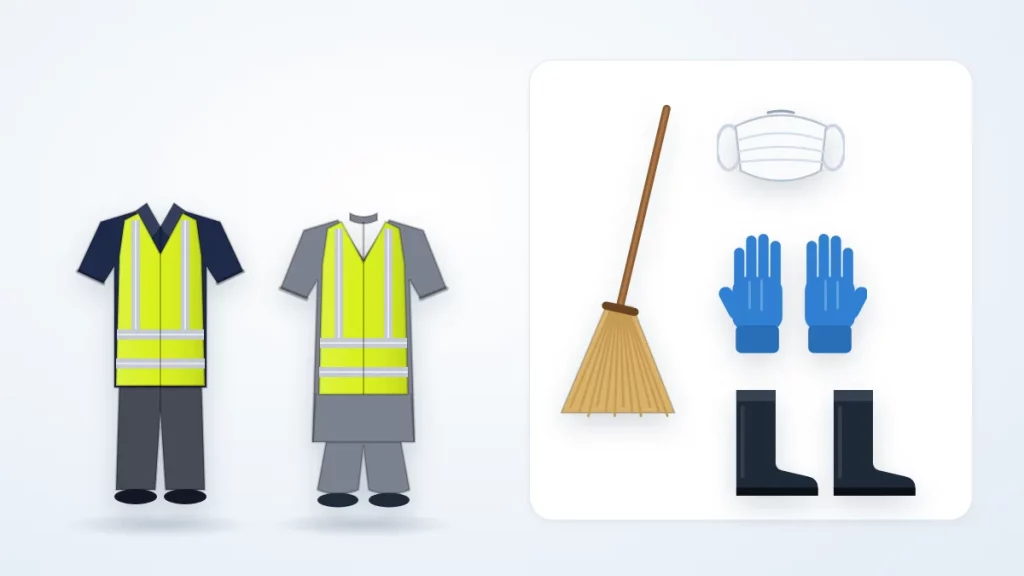
Safety gear that goes with a janitorial uniform
A janitorial uniform is not protective equipment. It keeps staff tidy and identifiable, but cleaning chemicals, wet floors and outdoor traffic need separate safety gear (PPE) worn with the uniform.
| Safety item | When cleaning staff need it | What to choose |
|---|---|---|
| Gloves | Handling cleaning chemicals, waste and sharp objects | Nitrile or rubber; heavy-duty gloves for waste collection |
| Footwear | Wet, polished or oily floors | Closed shoes with slip-resistant soles; waterproof boots for washing areas |
| Dust mask | Sweeping, dusting and dry waste | Disposable or washable mask, changed regularly |
| Goggles | Spraying or mixing chemicals | Clear, splash-resistant goggles |
| Waterproof apron | Washrooms, dishwashing, mopping with chemicals | PVC apron worn over the uniform |
| Hi-vis vest | Roads, car parks, loading bays | Fluorescent vest with reflective tape |
Two rules keep this simple:
- Check the chemical label first. Each cleaning chemical’s label or safety data sheet states the protection it needs, so match gloves and goggles to the products your team actually uses.
- Treat drain and sewer cleaning as specialist work. Punjab’s PMDFC safety SOPs call for impermeable coveralls, chemical-resistant boots, face protection and respiratory protection for liquid-waste workers. An ordinary janitorial uniform is not enough for that job.
How to order janitorial uniforms in bulk
To order janitorial uniforms in bulk, count your cleaning staff by role, plan at least three sets per person, approve a fabric and logo sample, then order each colour in one batch. These six steps work for a single office or a facility company running several sites.
- List staff by role and site. Room attendants, public-area cleaners, washroom staff, outdoor sweepers and supervisors may each need a different kit.
- Plan three sets per person. One worn, one in the wash, one spare. Teams doing heavy or wet cleaning every day, or covering double shifts, usually need four or five.
- Take sizes from staff, not from a guess. Cleaning work means bending and stretching, so a size set to try on avoids tight shoulders and short tunics.
- Approve a sample with your logo. Check the fabric, colour, stitching and embroidery on one finished piece before bulk production starts.
- Order each colour in one batch. Two batches of “navy” can come out slightly different, so order the whole team together, with a few spare sets in the most common sizes for new joiners.
- Plan by season. Order summer uniforms before April and winter jackets or jerseys before November, so they arrive before the weather turns.
At Saad Enterprises, our team brings fabric swatches and sample garments to your office in Rawalpindi or Islamabad, and keeps your approved shades, logos and size charts on file so reorders match the first batch. Bulk orders usually start from 50 sets per design; our page on how bulk orders work in Rawalpindi and Islamabad explains quotes, samples and delivery.
How much do janitorial uniforms cost in Pakistan?
The price of janitorial uniforms in Pakistan depends on five things: the garment (a tunic costs less than a coverall), the fabric and GSM, the branding method (embroidery or print), the number of sets and any special finish such as stain-release Every quote should state the fabric, GSM, branding and per-piece price in writing.
How long does a bulk order take?
Production time for janitorial uniforms depends on the quantity, the fabric in stock and the branding. Allow extra time for sample approval and logo changes, and avoid ordering right before a peak season such as the start of winter.
Frequently asked questions
What do janitors wear?
Janitors usually wear a tunic or work shirt, durable trousers and an apron, with closed, slip-resistant shoes. Offices often choose polo shirts, factories use coveralls, and outdoor sweepers add a high-visibility vest. Gloves and other safety gear are worn with the uniform for chemical work.
What is the best colour for janitorial uniforms?
Navy, charcoal grey and maroon are the most practical colours for janitorial uniforms because they hide dirt and water marks. Hospitals often use light blue or teal for cleaning staff, and outdoor crews need fluorescent yellow or orange vests on top.
What fabric is best for cleaning staff uniforms?
A poly-cotton blend of about 150–220 GSM is best for most cleaning staff. It survives daily washing, dries quickly and holds its colour longer than pure cotton. Heavier twill suits coveralls and outdoor work.
What is the difference between janitorial and housekeeping uniforms?
Housekeeping uniforms are for room attendants in hotels and hospitals and usually look smarter. Janitorial uniforms cover general cleaning, washrooms and maintenance, so they are built tougher, in darker colours, often with aprons or coveralls. Many manufacturers make both from the same fabrics.
What should a sweeper wear in Pakistan?
An outdoor sweeper in Pakistan should wear a durable shirt and trousers or kameez under a high-visibility vest, with gloves, a dust mask and sturdy shoes. Punjab’s PMDFC safety SOPs (June 2024) list these items for sweeping work.
Do hospital cleaning staff in Punjab have to wear uniforms?
Yes. In October 2026, the Punjab Healthcare Commission directed Category I and II-A healthcare establishments to make sanitation staff wear standard uniforms on duty, with 30 days to comply. Staff may not wear these uniforms outside hospital premises.
How many uniforms does each cleaner need?
Plan at least three sets per cleaner: one worn, one in the wash and one spare. Staff doing heavy or wet cleaning every day, or covering double shifts, usually need four or five sets.
Can janitorial uniforms carry a company logo?
Yes. Embroidery on the chest is the most durable option for tunics, shirts and polos, while printing suits large text on the back, such as “Housekeeping” or a contractor’s name. Approve a logo sample before bulk production.
Related guides
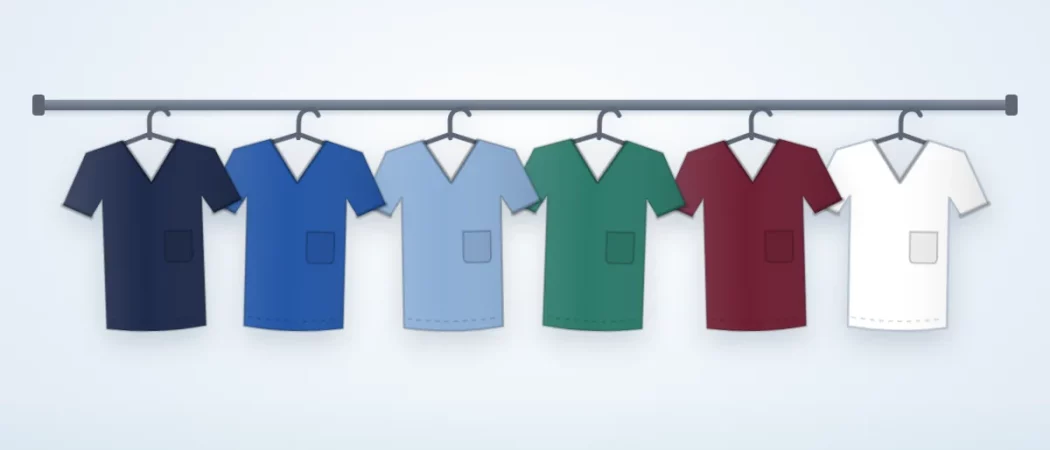
Scrub Colours and What They Mean in Hospitals
Walk into any hospital, and the scrubs tell you who does what, if you know the code. Here are the scrub colours most hospitals follow: green or teal for the operation theatre (OT), navy or teal blue for nurses and general clinical staff, burgundy for emergency and blood collection, and white for lab staff and doctors’ coats. No law sets these colours worldwide, so every hospital writes its own code.
This guide gives you a quick colour chart, what each colour means and who wears it, the rules Pakistan introduced in 2026, and a step-by-step way to choose scrub colours for your own hospital. We make medical and hospital uniforms in Rawalpindi, so the last part covers the fabric and shade checks we run before a hospital order goes into production.
Scrub colour chart: who wears what
The scrub colour chart below shows the patterns most hospitals follow. Use it as a starting point, then check your own hospital’s dress code, because colours change from one hospital to the next.
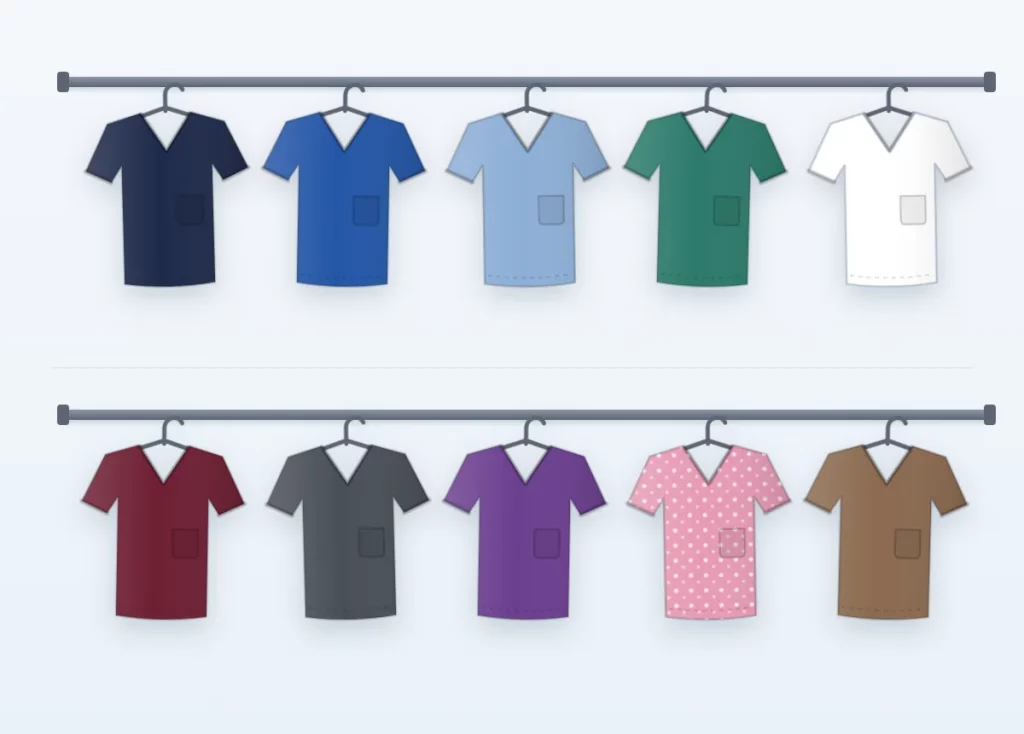
| Scrub colour | What it usually signals | Who usually wears it | Where you’ll see it |
|---|---|---|---|
| Navy blue | Authority, trust; hides stains well | Senior nurses, doctors, nurse managers | Wards, ICU, OPD |
| Royal blue | Calm and approachable | Nurses and general clinical staff | Wards, clinics |
| Ceiling (light) blue | Clean and calm; low glare | Nursing assistants, students, OT staff in some hospitals | OT, general wards |
| Green or teal | Surgery; rests the eyes against red | Surgeons, anaesthetists, OT technicians | OT, recovery, endoscopy |
| White | Cleanliness and tradition | Lab staff, pharmacists, doctors’ coats; nurses in Pakistan since July 2026 | Labs, pharmacy, wards |
| Burgundy, wine or maroon | Urgency and energy; hides stains | Emergency staff, phlebotomists, some therapists | Emergency, blood collection |
| Grey, charcoal or black | Neutral and modern | Admin staff, imaging technicians, security | Reception, radiology, private clinics |
| Purple or plum | Compassion, specialist care | Paediatric and oncology teams, some senior nurses | Specialist units |
| Pink or printed | Warm and friendly | Paediatric and maternity teams | Children’s wards, labour rooms |
| Brown or earth tones | Calm, less clinical | Psychiatry and therapy teams | Mental health units |
In Punjab, the Punjab Healthcare Commission’s October 2026 directive sets three of these for covered hospitals and clinics: blue for doctors, green for paramedical staff, and white coats for lab staff. The Pakistan section below has the details.

What do different scrub colours mean?
Each scrub colour carries a mix of practical reasons (stain hiding, glare, visibility) and the impression it gives patients. Here is what each one means and when a hospital tends to pick it.
Navy blue scrubs
Navy blue scrubs signal experience and authority, which is why many hospitals give navy to senior nurses, charge nurses, or doctors. Navy is also the most forgiving colour on a long shift: it hides ink, iodine, and small stains better than any light shade. The trade-off in Pakistan’s summer is heat, since dark fabric absorbs more sunlight on the walk between blocks.
Royal blue and ceil blue scrubs
Royal blue and teal blue scrubs read as calm and approachable, so they suit staff who spend all day at the bedside. Ceil blue, the soft greyish light blue, is also common in operation theatres because it cuts glare under bright lights. Hospitals often use navy for senior staff and teal or royal for juniors, which makes rank visible at a glance.
Green and teal scrubs
Green and teal scrubs mean surgery in almost every country. Green sits opposite red on the colour wheel, so looking at a green gown between glances at blood and tissue rests a surgeon’s eyes and stops the after-image effect described in the history section below. That is why OT teams, anaesthetists and recovery staff wear green even in hospitals that use other colours everywhere else.
White scrubs and coats
White stands for cleanliness and is the oldest medical uniform colour. Labs, pharmacies and doctors’ white coats still use it, and Pakistan’s nursing council brought white back for all nurses in July 2026. White also tests well with patients: in a 2008 Cleveland Clinic study, adults rated nurses in white highest on all ten professionalism traits measured, while children and young adults showed little difference between uniforms. The downside is upkeep, since every stain shows.
Burgundy, wine and maroon scrubs
Burgundy, wine and maroon scrubs signal urgency and energy, which suits emergency departments, trauma teams and phlebotomy. The deep red hides blood stains well and stands out in a crowded emergency ward, so patients can find staff quickly.
Grey, charcoal and black scrubs
Grey, charcoal and black scrubs look modern and neutral. Hospitals use them for administration, imaging and radiology technicians, and security, while private clinics and dental or cosmetic practices often choose black for a polished look. Black hides stains but fades quickly if the dye quality is poor.
Purple, pink and printed scrubs
Purple, pink and printed scrubs soften the clinical feel of a ward. Paediatric, maternity and oncology teams use them to make children and anxious patients more comfortable. Prints work best on children’s wards; keep them out of the OT and emergency, where a plain colour code matters more than comfort.
Brown and earth-tone scrubs
Brown and earth-tone scrubs are rare, but psychiatry and therapy teams sometimes use them to make a unit feel less like a hospital. The muted shades help patients who find clinical settings stressful.
Scrub colours by role and department
Scrub colours by role follow a loose global pattern: blue for doctors and nurses, green for surgery, red tones for emergency, white for labs. The answers below cover the questions people search most.
What colour scrubs do doctors wear?
Doctors most often wear navy, royal blue, or grey scrubs, usually under a white coat that marks them out on ward rounds. Surgeons switch to green or teal blue in the OT. In Punjab, the Punjab Healthcare Commission now requires blue uniforms for doctors and says facilities must provide white coats or overalls.
What colour scrubs do nurses wear?
Internationally, nurses wear navy, royal blue or teal blue scrubs, with darker shades often reserved for senior or registered nurses. Pakistan is the exception: since July 2026, the Pakistan Nursing and Midwifery Council requires white uniforms for all nurses, replacing the deep navy introduced in January 2024. ICU and OT nurses follow their own hospital’s policy.
What colour do surgeons and OT staff wear?
Surgeons, anaesthetists, scrub nurses and OT technicians wear green, teal or cerulean blue. These shades reduce eye strain under surgical lights and make blood easier to read against the fabric. Many hospitals keep OT scrubs for the theatre only, so a different colour in the corridor shows who has left the sterile zone.
What colour do emergency staff wear?
Emergency staff often wear burgundy, wine or dark red scrubs, and some hospitals use black or charcoal instead. The aim is to make the emergency team easy to spot in a crowded department and to hide stains during long, unpredictable shifts.
What colour do medical students and house officers wear?
Medical students and house officers usually wear a lighter shade than senior staff, such as ceil blue or grey, often with a white coat. Each college and teaching hospital sets its own rule, so students should check their department’s dress code before buying.
What colour do lab, pharmacy and support staff wear?
Lab staff and pharmacists usually wear white coats over scrubs or plain clothes, and the Punjab directive now makes white coats the standard for lab personnel. Admin, reception and imaging staff tend to wear grey, charcoal or black. Housekeeping and security staff wear their own designated uniforms, which the Punjab directive also covers.
Scrub colours in Pakistan: the 2026 rules
Pakistan now has two official uniform rules that decide scrub and uniform colours for many hospitals: the nursing council’s white uniform for nurses (July 2026) and the Punjab Healthcare Commission’s colour directive (October 2026). Most global scrub guides miss both.
| Rule | Applies to | What it requires | Reported |
|---|---|---|---|
| PNMC nurse uniform circular | Nurses across Pakistan | Female nurses: white shalwar kameez, white coat, white dupatta, black shoes. Male nurses: white shirt, white trousers, black shoes. Black jersey or coat allowed in winter. ICU and OT follow hospital policy. | 16 July 2026 |
| Punjab Healthcare Commission directive | Category I and II-A healthcare establishments in Punjab | Doctors in blue, paramedical staff in green, lab staff in white coats, sanitation staff in standard uniforms. Half sleeves for infection control. No uniforms outside hospital premises. Special kits for OT staff. 30 days to comply. | 30 October 2026 |
Nurses: back to white after two years of navy
The Pakistan Nursing and Midwifery Council reversed its January 2024 switch to deep navy and reinstated white for all nurses, with immediate effect. The council said white restores the traditional professional look and helps the public recognise nursing staff. For hospitals, this means nurse uniforms ordered in navy since 2024 now need replacing, except in ICUs and theatres, where the hospital sets the colour.
Punjab: blue for doctors, green for paramedics
The Punjab Healthcare Commission gave covered facilities 30 days to put doctors, paramedics, lab and sanitation staff into prescribed uniforms. Two rules affect the garment itself, not just the colour: uniforms must be half-sleeved, and staff may not wear them outside the hospital. Plan for short-sleeve scrub tops and enough sets per person to change on site.
News reports differ slightly on doctors: one says blue uniforms, another says facilities must provide white coats or overalls. Both can apply at once (blue scrubs under a white coat), but read the commission’s official notification before you place an order.
What this means if you run a hospital in Pakistan
If you are in Punjab, three colours are already decided for you: blue for doctors, green for paramedics, white for lab staff and nurses. Your remaining choices are the shades, the colours for OT, ICU, admin and support teams, and the fabric. Sanitation staff need their own set too; see our housekeeping uniforms for the options we make.
Why surgeons wear green: a short history
Surgeons wear green because white caused glare and after-images in the operating theatre. Until the early 1900s, surgeons operated in white gowns in white rooms to show cleanliness. Under bright lights, white reflected harshly, and staring at red blood and tissue left a green “ghost” image whenever a surgeon glanced at a white gown or wall.
In 1914, San Francisco surgeon Harry Sherman switched to green, a change the American College of Surgeons records in its history of surgical attire. Green cancels the after-image because it sits opposite red on the colour wheel, and it reflects less light than white. Over the following decades, operating theatres moved to green and later to blue, and the rest of the hospital gradually adopted colour codes of its own.
That history explains today’s pattern: green and blue in the OT for the eyes, darker shades on the wards for stains, and white kept for coats and labs, where it still signals hygiene.
How to choose scrub colours for your hospital
To choose scrub colours for your hospital, start with the rules that already bind you, then give each staff group one clearly different colour and lock the exact shade before ordering. These eight steps work for a small clinic or a large hospital.
- Check the rules first. Nurses follow the PNMC white uniform. In Punjab, doctors, paramedics, and lab staff follow the Punjab Healthcare Commission directive. Everything else is your choice.
- List every staff group and headcount. Doctors, nurses, OT, ICU, emergency, lab, pharmacy, admin, housekeeping, kitchen, and security. Headcount decides order size and how many spare sets you need.
- Keep the palette small. Four to six colours are easy for patients and staff to remember. Ten colours turn into guesswork.
- Separate by contrast, not shade. Navy next to cerulean blue works; royal blue next to cobalt does not. Red-green colour blindness is the most common type, so never rely on red versus green alone to tell two groups apart.
- Name each shade precisely. “Blue” means something different to every supplier. Approve a physical fabric swatch or colour code for each group and keep it on file for reorders.
- Add role labels. Embroider the role or department on the chest, or use colour-matched name badges, so nobody depends on colour alone.
- Plan non-clinical staff too. Reception, housekeeping and hospital security uniforms should look clearly different from clinical scrubs, so patients never mistake a guard for a nurse.
- Put the code on the wall. A simple colour chart at reception and on each ward tells patients and visitors who they are talking to.
If you are buying for the first time, our bulk uniform procurement guide walks through sourcing uniforms in bulk.
Fabric, fading and Pakistan’s heat.
A colour code only works if the colours stay the same after months of washing. Fabric, dye quality and climate decide whether your navy stays navy or turns patchy grey by the second summer.
- Pick a blend for colour, cotton for comfort. Polyester-cotton blends hold dye better through repeated hot washes than 100% cotton, while cotton breathes better. A blend is the practical choice for daily scrubs; pure cotton suits staff who put comfort first.
- Match colour to climate. Light shades such as ceil blue, white and light green stay cooler in summer heat. Navy, black and burgundy hide stains but trap more heat, which matters for staff who walk between buildings.
- Go half-sleeve where required. Punjab’s directive asks for half-sleeved uniforms for infection control, so order short-sleeve tops for covered facilities.
- Ask for a wash-fastness test. ISO 105-C06 is the international test for colour fastness to domestic and commercial laundering. A supplier should be able to tell you how its fabric scores.
- Order each colour from one dye lot. Two batches of “navy” can differ slightly. Ordering a full department at once, plus spare sets, keeps the colour consistent.
- Wash darks separately. Wash coloured scrubs inside out, keep them away from chlorine bleach, and never mix white uniforms with dark scrubs.
As a uniform manufacturer in Rawalpindi, Saad Enterprises makes scrubs, lab coats, and nurse uniforms from 50 sets, with your hospital’s logo or each department’s name embroidered on the chest.
Frequently asked questions
What do the different scrub colours mean?
Scrub colours show a hospital worker’s role or department. Green or teal usually means surgery, navy or teal blue means nursing or general clinical staff, burgundy means emergency, white means lab staff or doctors’ coats, and grey or black means admin or support.
Is there a universal scrub colour code?
No. No international law sets scrub colours, so each hospital writes its own code. In Pakistan, the PNMC sets white for nurses, and in Punjab the Punjab Healthcare Commission sets blue for doctors, green for paramedics, a nd white coats for lab staff.
What colour scrubs do doctors wear in Pakistan?
In Punjab, doctors must wear blue under the Punjab Healthcare Commission’s October 2026 directive, with white coats or overalls provided by the facility. Elsewhere in Pakistan, navy or blue scrubs under a white coat are common, and surgeons wear green in the OT.
What colour uniform do nurses wear in Pakistan?
White. Since July 2026, the Pakistan Nursing and Midwifery Council requires white uniforms for all nurses, replacing the navy introduced in 2024. Female nurses wear a white shalwar kameez, coat, and dupatta; male nurses wear a white shirt and trousers. ICU and OT follow hospital policy.
Which colour is best for scrubs?
Navy blue is the most practical all-round colour because it hides stains and suits most roles. Green or cerulean blue is best for surgery, and lighter shades stay cooler in hot weather. The right colour is the one your hospital assigns to your role.
What is the most popular scrub colour?
Blue, in navy, royal, and teal shades, is the most widely worn scrub colour, followed by surgical green. Blue suits almost every role, darker blues hide stains, and patients link the colour with calm, dependable care.
Why do surgeons wear green scrubs?
Green reduces glare and eye strain under bright theatre lights. Because green sits opposite red on the colour wheel, it cancels the green after-image surgeons see after looking at blood. Surgeons began switching from white to green in 1914.
What do the scrub colours mean in Grey’s Anatomy?
In Grey’s Anatomy, surgical attendings wear navy, and interns and residents wear light blue. OB/GYN staff wore pink until season 19, when they switched to black. Many real hospitals use a similar split: darker blue for senior staff, lighter blue for juniors.
What colour scrubs do patients trust most?
In a 2008 Cleveland Clinic study, adults rated nurses in white uniforms highest on professionalism traits such as competence and reliability. Children and young adults showed little preference between uniforms, so the effect depends on who your patients are.
Can hospital staff choose their own scrub colours?
Only where the hospital allows it. Most hospitals assign colours by role, and nurses in Pakistan must now wear white. Private clinics often give staff more freedom, but check your dress code before buying.
Get scrubs made in your hospital’s colours.
Saad Enterprises makes scrubs, lab coats and nurse uniforms in Rawalpindi from 50 sets, with your logo or department names embroidered on the chest. Send us your staff list and colour code, and we’ll quote by department. Request a quote or message us on WhatsApp at +92 331 5050974.
Related guides
Security Guard Uniform Kit: A Guide for Security Companies
Choosing the right security guard uniform colours is an important decision for security companies, corporate offices, residential societies and industrial facilities. A well-designed uniform helps identify security personnel, creates a professional appearance, and makes guards easier to recognise by employees, visitors and customers.
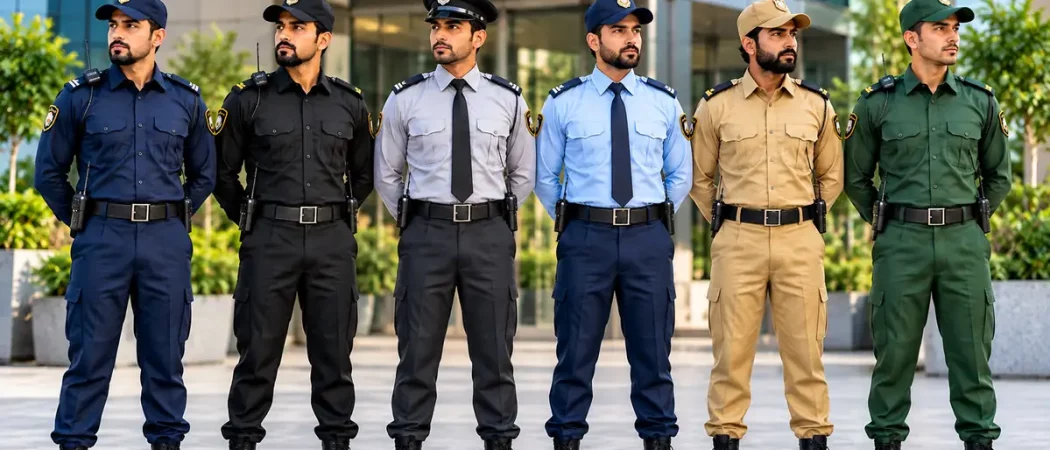
Common security guard uniform colours include navy blue, black, grey, light blue, khaki and green. The right choice depends on the organisation’s branding, working environment, visibility requirements, and the responsibilities of security personnel.
This guide explains popular security guard uniform colours, practical colour combinations, standard dress codes, and the essential items included in a complete security guard uniform kit. It also helps security companies in Pakistan plan uniforms according to their operational requirements. Our security guard uniform list shows what goes into a full kit.
What Colours Do Security Guards Wear?
Security guards commonly wear navy blue, black, grey, light blue, khaki, and green uniforms. Navy blue and black are popular for corporate and private security teams, while grey, light blue and khaki offer alternative professional appearances. Green may be selected for outdoor sites or specific organisational branding.
There is no single universal colour requirement for every security company. The appropriate colour depends on company policy, client requirements, local regulations, and the environment in which guards work.
Why Do Security Guards Wear Uniforms?
Security guards wear uniforms to make their role identifiable, maintain a consistent professional appearance, and help people distinguish authorised security personnel from other staff and visitors.
A properly designed uniform serves several practical purposes:
- Easy identification: Employees, visitors, and customers can recognise security personnel.
- Professional appearance: Matching uniforms create a consistent image across security teams.
- Authority and recognition: A clear uniform design helps communicate the guard’s official role.
- Organisational identity: Company logos, badges and name plates help distinguish one security provider from another.
- Operational consistency: Standardised clothing makes it easier to manage teams across multiple locations.
- Workplace suitability: Appropriate fabrics and accessories support comfort and movement during duty.
A uniform should support security operations rather than simply look attractive. Its design should reflect the location, duties, and practical needs of the guards.
Popular Security Guard Uniform Colours and Their Uses
Security guard uniform colours can influence how a team is visually perceived. However, colour associations are not universal rules. Companies should consider their brand identity, client expectations, and working conditions before selecting a colour.
1. Navy Blue Security Guard Uniforms
Navy blue is a popular choice for corporate security teams, banks, offices, commercial buildings, and private security companies.
It creates a formal and coordinated appearance and works well with white, light blue, and grey details. Companies can also add embroidered logos, shoulder badges, and name plates to distinguish their personnel.
Recommended for: Corporate offices, banks, residential societies, commercial buildings and private security agencies.
2. Black Security Guard Uniforms
Black security uniforms are often selected for private security teams, events and assignments where a smart, formal appearance is preferred.
Black shirts, trousers and jackets can be combined with contrasting badges, embroidered logos or reflective details where appropriate.
For outdoor duties in hot weather, companies should carefully consider fabric weight, breathability and the amount of time guards spend in direct sunlight.
Recommended for: Private security companies, event security, selected corporate environments and indoor assignments.
3. Grey Security Guard Uniforms
Grey is a versatile option for organisations that want a professional appearance without choosing a very dark uniform.
Light grey shirts can be paired with charcoal or black trousers, while darker grey garments can be used for a coordinated uniform set.
Grey also works well with navy blue, black and white branding elements.
Recommended for: Commercial buildings, shopping centres, offices and facility management teams.
4. Light Blue Security Guard Uniforms
Light blue shirts offer a clean and distinctive appearance, particularly in customer-facing environments.
They can be paired with navy blue or black trousers and a matching cap. Companies may also use darker shoulder panels or contrasting collars to create a consistent design.
Recommended for: Reception security, corporate offices, commercial buildings and customer-facing assignments.
5. Khaki Security Guard Uniforms
Khaki is an established uniform colour that can be suitable for outdoor and operational environments.
Khaki shirts and trousers can be combined with dark brown, black or olive accessories. The colour and fabric should be selected according to the working environment and the company’s uniform policy.
Recommended for: Outdoor security assignments, selected industrial sites and organisations that prefer a traditional uniform appearance.
6. Green Security Guard Uniforms
Green uniforms can help create a distinctive identity for security teams working in outdoor environments or locations with specific organisational branding.
Different shades, including olive and dark green, can be paired with black or khaki trousers.
Recommended for: Residential communities, outdoor facilities, parks and site-specific security teams.
Security Guard Uniform Colour Combinations
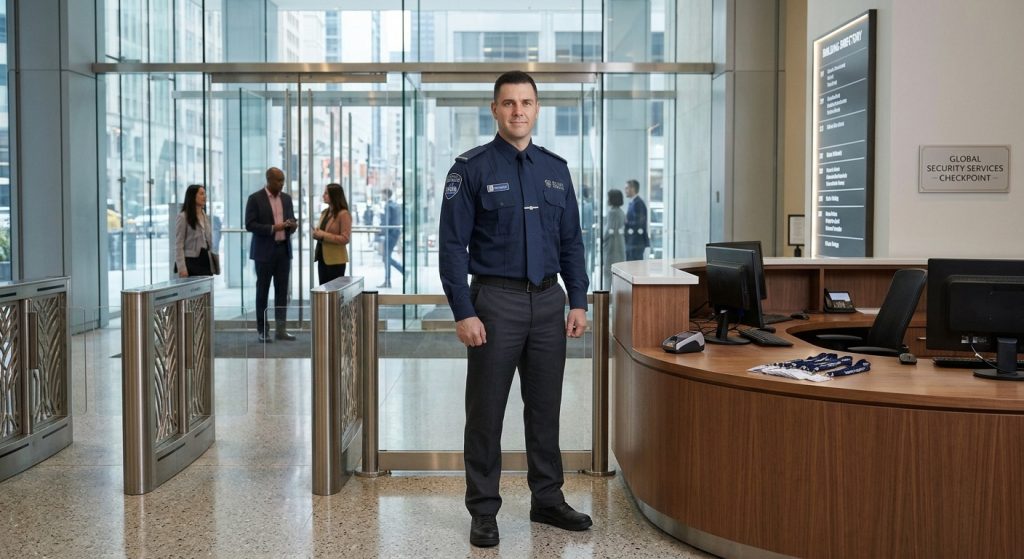
Selecting a suitable colour combination is just as important as choosing the main uniform colour. Shirts, trousers, caps, jackets, and accessories should create a consistent appearance.
The following combinations are practical design suggestions rather than mandatory uniform standards.
| Environment | Suggested Shirt Colour | Suggested Trouser Colour | Design Consideration |
|---|---|---|---|
| Banks and corporate offices | Light blue or navy | Navy or black | Formal and consistent appearance |
| Residential societies | Navy blue | Black or navy | Easy identification across teams |
| Shopping malls | Grey or light blue | Black | Professional customer-facing appearance |
| Industrial facilities | Navy or grey | Dark grey or navy | Practical fabric and site suitability |
| Outdoor security | Khaki or green | Matching dark trousers | Suitable for outdoor working conditions |
| Event security | Black | Black | Consistent appearance for event teams |
| Construction sites | Navy or grey | Dark work trousers | Consider additional high-visibility clothing where risk assessment requires it |
Before finalising a combination, security companies should check the client’s branding requirements and ensure that the uniform does not create confusion with emergency services or other authorised personnel.
What Is a Security Guard Uniform Dress Code?
A security guard uniform dress code is a set of clothing, identification, and appearance requirements established by a security company or its client. It defines what guards must wear while on duty, including shirts, trousers, footwear, badges and approved accessories.
A standard dress code may include:
- A company-approved security shirt.
- Matching or contrasting trousers.
- An approved cap or headwear.
- A visible company badge or identification.
- A nameplate, where required.
- Suitable footwear for the duty environment.
- An approved jacket or outer layer for colder conditions.
- Additional safety equipment where the job risk assessment requires it.
Security companies should document their uniform policy so that employees across different shifts and locations follow the same standards.
What Is Included in a Complete Security Guard Uniform Kit?
A complete security guard uniform kit includes the clothing and identification items required for the guard’s assigned duties. The exact kit varies by company, location, season, and operational responsibilities.
| Uniform Item | Purpose |
|---|---|
| Security shirt | Main upper-body uniform |
| Security trousers | Comfortable and practical lower-body clothing |
| Security cap | Consistent team appearance and identification |
| Uniform jacket | Additional layer for cold or outdoor conditions |
| Belt | Supports the uniform and approved accessories |
| Company badge | Displays organisational identity |
| Name plate | Identifies individual personnel |
| Suitable footwear | Supports comfort and safe movement |
| Reflective vest or jacket | Improves visibility when required by site conditions |
Security Guard Shirts
Security shirts should provide a professional appearance while allowing guards to move comfortably during duty.
Common design options include short-sleeved and long-sleeved shirts, button-front designs, chest pockets, shoulder epaulettes, and embroidered company logos.
The final design should reflect the company’s uniform policy and the operational requirements of the security team.
Security Guard Trousers
Security trousers should allow comfortable movement, particularly for guards who spend long periods standing, walking or conducting patrols.
Companies should consider fabric durability, stitching, pocket placement, waistband comfort and the overall fit before ordering trousers in bulk.
Security Guard Caps
Caps help create a consistent appearance and can provide some protection from direct sunlight during outdoor assignments.
A cap can include an embroidered company logo or approved identification detail. Its colour should coordinate with the shirt and trousers.
Security Jackets and Outerwear
Security jackets are useful for guards working during colder weather, night shifts, or outdoor assignments.
Companies can choose matching jackets, lightweight outerwear, ear protection, or other suitable garments according to the season and working environment.
Badges, Name Plates and Identification
Badges and name plates help identify security personnel and distinguish them from other workers.
Their design, placement and wording should follow company policy and any applicable client or local requirements.
Footwear and Approved Accessories
Suitable footwear is important for guards who walk, stand, or patrol for extended periods.
Additional accessories should only be included when they are authorised and relevant to the assigned role. A uniform should not contain unnecessary equipment that interferes with movement or safety.
How to Choose the Right Security Guard Uniform Colours
Security companies should evaluate the working environment, brand identity, job responsibilities and practical requirements before selecting uniform colours.
Consider these six steps:
1. Identify the working environment
Determine whether guards will work in offices, residential societies, shopping centres, industrial facilities, construction sites, or outdoor locations. Different environments may require different uniform designs.
2. Consider company branding
Choose colours that complement the company’s visual identity. Logos, badges and name plates should remain visible against the selected fabric colour.
3. Define the uniform dress code
Decide which items are mandatory, including shirts, trousers, caps, jackets and identification. Maintain a consistent standard across all locations.
4. Select suitable fabrics
Consider cotton, poly-cotton blends, twill or ripstop fabrics according to the expected duty conditions. Compare fabric weight, breathability, durability, and maintenance requirements before placing an order.
5. Evaluate visibility and safety
If guards work near moving vehicles, loading areas, construction activity, or other hazards, assess whether additional high-visibility clothing is necessary. Select such clothing according to the relevant risk assessment and applicable safety requirements.
6. Approve a sample before bulk production
Review the colour, fabric, sizing, stitching, logo placement, and overall fit before confirming a large uniform order. Sample approval helps reduce inconsistencies across the final batch.
Which Fabric Is Best for Security Guard Uniforms?
The best fabric for security guard uniforms depends on the working environment, expected duty hours, weather conditions, maintenance requirements, and budget.
Common fabric options include:
- Cotton: A natural fabric option that can be suitable where comfort and breathability are priorities.
- Poly-cotton: A blended fabric that combines cotton and polyester characteristics. Its performance depends on the actual fabric composition and construction.
- Twill: A fabric weave commonly used in workwear because of its structured appearance.
- Ripstop: A reinforced fabric construction designed to help limit the spread of small tears.
Companies should compare fabric specifications and request samples rather than selecting material based on its name alone.
Security Uniforms for Industrial and Outdoor Sites
Security guards working in industrial facilities, warehouses, construction sites, and outdoor locations may face different conditions from guards working in offices or reception areas.
Their uniforms should be selected according to the site environment and job responsibilities.
For example, industrial sites may require durable clothing, practical pockets, and suitable outerwear. Where a risk assessment identifies a need for enhanced visibility, additional high-visibility garments may be appropriate.
High-visibility clothing is not simply a matter of choosing a bright colour. Relevant standards, such as ISO 20471, address requirements involving fluorescent materials, retroreflective materials, material areas and placement. Whether a garment needs to meet a particular standard depends on the identified risk and applicable workplace requirements.
For industrial workwear options, explore our workwear and industrial uniforms.
For construction-related requirements, you can also view our construction uniforms.
Security Guard Uniform Requirements for Women
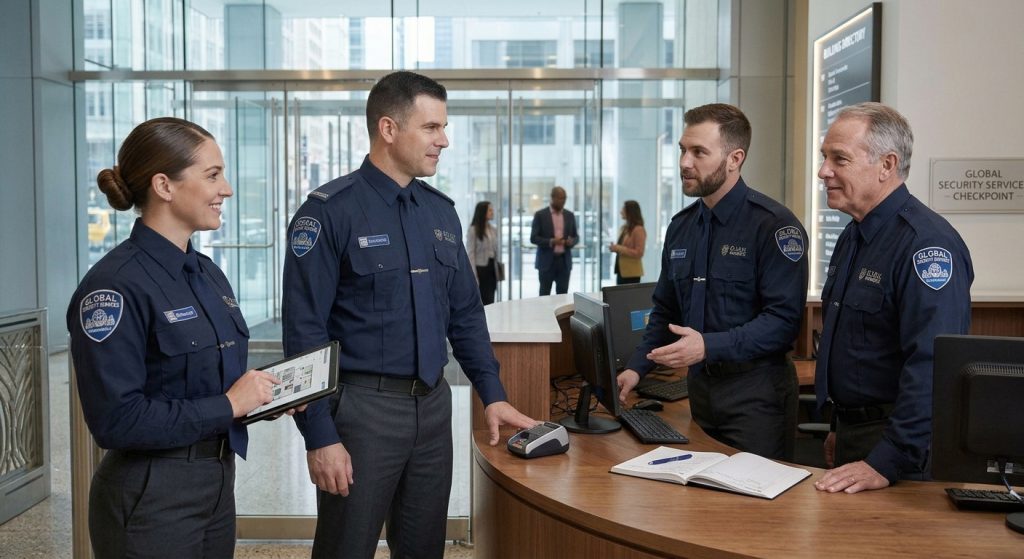
Security companies should also consider the fit and practical requirements of female security personnel when developing a uniform policy.
Uniform options should provide appropriate sizing, comfortable movement, and consistent company identification. Shirts, trousers, jackets, and other garments should be available in suitable fits rather than relying on a single standard pattern for every employee.
The design should maintain a consistent organisational appearance while accommodating the needs of individual team members.
Security Guard Uniform Bulk Ordering Checklist
Before ordering security guard uniforms in bulk, procurement managers should confirm the following details:
| Requirement | What to Confirm |
|---|---|
| Uniform colour | Approved shirt, trouser and jacket colours |
| Design | Final design and approved branding |
| Fabric | Material composition, weight and construction |
| Sizes | Individual size measurements |
| Quantity | Total quantity and size-wise breakdown |
| Logo | Embroidery or printing requirements |
| Identification | Badge and nameplate specifications |
| Accessories | Caps, belts, jackets and other approved items |
| Samples | Approval of fabric and finished sample |
| Quality | Stitching, finishing and size consistency |
| Delivery | Agreed production and delivery schedule |
For large teams, a size-wise employee list and an approved sample can make the ordering process more organised.
Security Uniform Manufacturing and Supply in Rawalpindi and Islamabad
Security companies need uniforms that reflect their identity while meeting the practical requirements of their teams.
Saad Enterprises provides uniform manufacturing and supply services for businesses and organisations in Rawalpindi and Islamabad. Companies planning security uniforms can discuss their preferred colours, designs, fabric options, branding requirements, and quantities before confirming an order.
Explore our security uniform manufacturing and supply page to learn more about our security uniform range.
For other operational clothing requirements, you can also explore our coverall uniform range.
To discuss your requirements, contact Saad Enterprises.
Frequently Asked Questions About Security Guard Uniform Colours and Kits
What is the most common security guard uniform colour?
Navy blue and black are commonly selected for security uniforms. However, grey, light blue, khaki and green are also used depending on company branding, working environments and client requirements.
What colours do private security guards wear?
Private security guards may wear navy blue, black, grey, light blue or other company-approved colours. There is no single universal colour for every private security organisation.
Why do security guards wear black uniforms?
Some security companies select black uniforms for a coordinated and formal appearance. However, fabric weight, weather, and outdoor working conditions should be considered before choosing black clothing for regular outdoor duty.
What is the best colour combination for security uniforms?
Navy blue shirts with black or navy trousers are a practical option for many corporate environments. Other combinations should be selected according to the client’s branding and operational requirements.
What is included in a security guard uniform set?
A standard security guard uniform set may include a shirt, trousers, cap, belt, nameplate, and suitable footwear. Jackets and reflective clothing may be added when required.
What is a security guard uniform dress code?
It is a company- or client-approved standard that defines the clothing, identification, accessories, and appearance expected from guards while on duty.
Do security guards need reflective jackets?
Not every security guard requires a reflective jacket. It may be necessary when guards work near vehicles, construction activity, or other hazards where a risk assessment identifies a visibility requirement.
Can security companies customise uniform colours and logos?
Yes. Uniform designs can be planned around company-approved colours, logos, identification and garment requirements. The final specifications should be confirmed before bulk production.
How should a company order security guard uniforms in bulk?
Prepare the required quantities, size breakdown, preferred colours, fabric specifications and logo details. Approve a sample before confirming bulk production to maintain consistency.
Final Thoughts
The right security guard uniform colours and kit depend on the organisation’s identity, working environment and operational requirements. Navy blue, black, grey, light blue, khaki and green each offer different design possibilities.
A complete uniform should combine suitable shirts, trousers, caps, jackets, identification, and footwear. Security companies should also consider fabric performance, employee comfort, visibility requirements, and consistent sizing before placing bulk orders.
For businesses in Rawalpindi and Islamabad planning customised security uniforms, Saad Enterprises can help discuss uniform designs, colours, and manufacturing requirements.
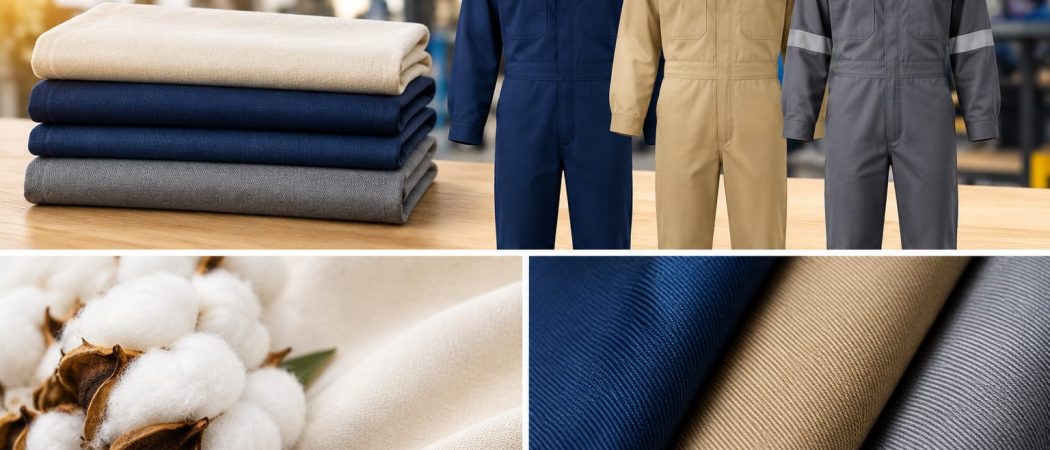
Best Fabric for Coveralls: Cotton, Twill or Poly-Cotton?
A coverall that is too hot gets unzipped and tied round the waist. One that tears at the crotch or fades after a month gets thrown away. Most of these problems come down to one choice made before the order: the fabric.
This guide compares the best fabric for coveralls used in Pakistani factories, workshops and sites: cotton drill, cotton twill, poly-cotton and heavy canvas. It explains which workwear fabric suits which job, what weight to choose, and which details matter as much as the cloth.
Short answer: for most factories and workshops, the best coverall fabric is a cotton-rich drill or twill of about 220–280 GSM. Choose 65/35 poly-cotton twill when coveralls are washed often or worn around oil and grease.
Best fabric for coveralls: the options compared
Each fabric trades comfort against strength and easy care in a different way.
| Fabric | Typical weight | Strengths | Weaknesses | Best for |
|---|---|---|---|---|
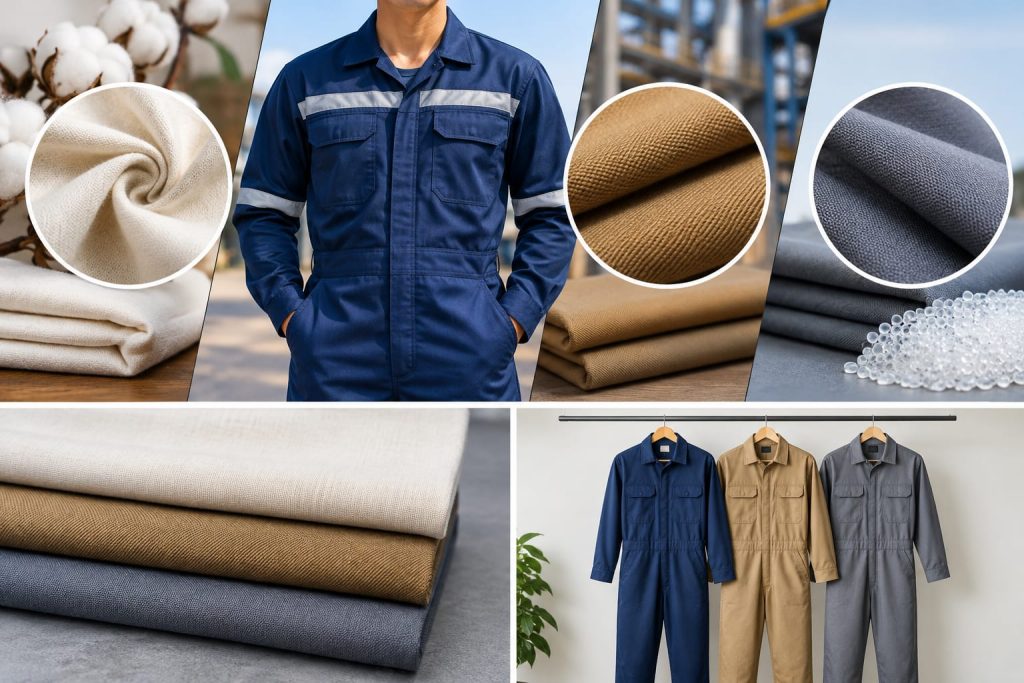
| 100% cotton drill | 220–280 GSM | Breathable, comfortable in heat, doesn’t melt near sparks | Shrinks unless pre-shrunk, fades faster | Workshops, maintenance, hot factory floors |
| Cotton twill | 220–280 GSM | Soft, strong, hides dirt | Slower to dry | General factory work |
| 65/35 poly-cotton twill | 200–250 GSM | Strong, holds colour, dries fast, little shrinkage | Warmer, melts near flame | Logistics, oily work, frequent washing |
| Heavy cotton canvas | 300+ GSM | Very tough and abrasion-resistant | Stiff and hot | Heavy industry, outdoor work |
These weights are typical ranges. We confirm the exact GSM on the swatch you approve.
What is the difference between drill and twill?
Drill is a heavy, tightly woven type of twill made for workwear. Regular cotton twill is a little softer and more flexible. Both have the diagonal weave that makes them stronger than plain-woven cloth, which is why drill and twill coveralls are the standard in most factories.
Cotton or poly-cotton: which is better for coveralls?
Cotton is better for heat and sparks, and poly-cotton is better for durability and easy care. Pick the fabric that suits the work environment, not just the price.
- Choose cotton coveralls for hot factory floors, workshops near grinding or sparks, and long summer shifts.
- Choose poly-cotton for oily, greasy work, frequent industrial washing, and when colour must stay bright.
- Choose certified flame-resistant fabric for welding, refineries, and any open-flame risk. Ordinary cotton is not flame-resistant; only fabric made to a standard such as ISO 11612 should be sold as fire-resistant.
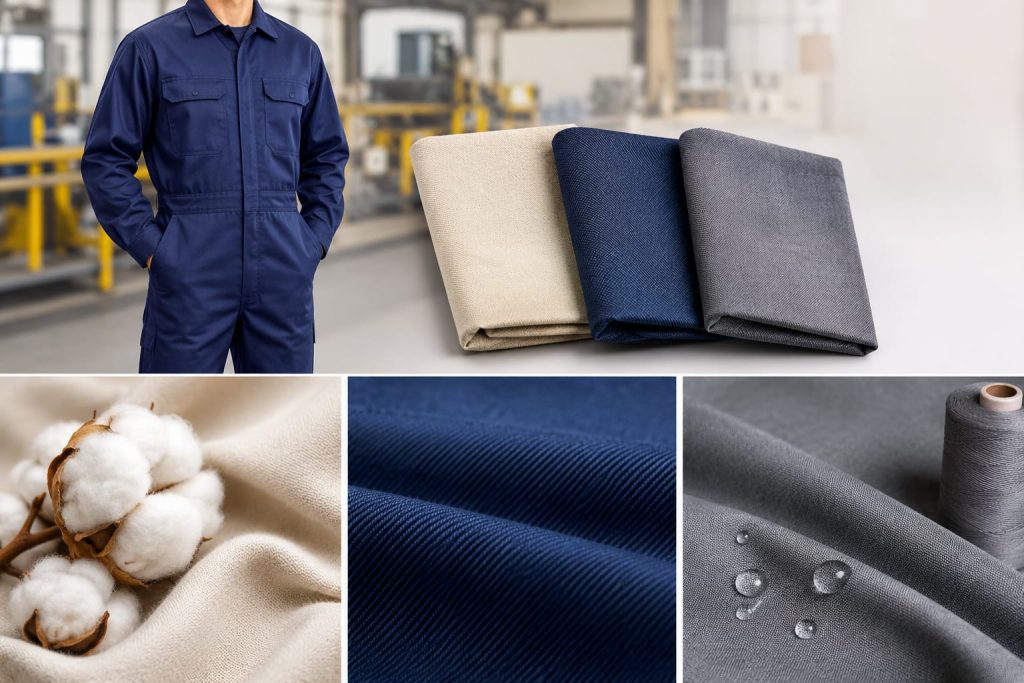
What GSM should a coverall be?
Most factory coveralls fall between 220 and 260 GSM. Go lighter for summer and lighter duty, and heavier for rough or outdoor work.
| Weight | GSM range | Use |
|---|---|---|
| Light | 180–220 | Summer shifts, packing and light assembly |
| Medium | 220–260 | General factory and maintenance work |
| Heavy | 260–320 | Heavy industry, outdoor and winter work |
Stitching and features matter as much as fabric
Good fabric fails early if the coverall is badly built. These are the details to check on the sample:
- Triple-needle stitching on the main seams, which take the most strain.
- Bar-tacks at pocket corners and the crotch.
- A concealed front zip or press studs so the zip can’t scratch machinery or vehicles.
- Elasticated back waist for a better fit across different body shapes.
- Reflective tape on arms and legs for sites, warehouses and night work.
- Useful pockets: chest pocket for a pen, side tool pocket and a phone pocket.
Best colours for coveralls
Navy, grey, bottle green and khaki hide grease and dust best. Orange and other high-visibility colours, with reflective tape, suit sites and road work where staff must be seen.
Ordering coveralls with your company logo
As coverall manufacturers in Pakistan with our own factory in Rawalpindi, we make cotton, twill and poly-cotton coveralls with your logo embroidered and reflective tape where needed. For staff who prefer a shirt and trousers, we also make two-piece industrial workwear, and site teams can be kitted out with construction uniforms with reflective tape.
Orders start from 50 sets, and you approve a sample before bulk production. Before you place a bulk order with any supplier, run through our 10 checks before a bulk uniform order.
Need coveralls for your team? Request a free bulk quote or WhatsApp +92 331 5050974 with your staff numbers and type of work.
Frequently asked questions
What is the best fabric for coveralls?
For most factories and workshops, a cotton-rich drill or twill of about 220–280 GSM. Choose 65/35 poly-cotton twill when coveralls are washed often or worn around oil and grease.
Are cotton or polyester coveralls better?
Cotton is cooler and safer near sparks because polyester can melt. Poly-cotton lasts longer, keeps its colour, and dries faster. Choose by the work environment.
What GSM is good for coveralls?
Around 220–260 GSM suits most factory work. Go lighter for hot summer shifts and heavier, up to about 320 GSM, for heavy industry and outdoor winter work.
Are cotton coveralls fire-resistant?
No. Ordinary cotton burns, although it doesn’t melt like polyester. Only fabric made or treated to a flame-resistance standard, such as ISO 11612, should be called fire-resistant.
Related guides

What Should Kitchen Staff Wear? A Uniform Guide
What should kitchen staff wear? A clean chef coat or tunic, kitchen trousers, an apron, a head cover, and closed, non-slip shoes, changed for a fresh set every shift. The details change with the job: a tandoor cook, a pastry chef, and a dishwasher face very different heat, mess and risk. For what drives the cost, see our guide to chef uniform prices in Pakistan.
This guide explains the basic kitchen uniform, what each kitchen role should wear, the kitchen dress code that goes with it, and which fabrics are safest in a hot Pakistani kitchen.
What should kitchen staff wear? The basic uniform
Every person who works in a commercial kitchen needs five things. The first four are uniform; shoes come from a safety footwear supplier.
- Chef coat or tunic to protect the body from heat and splashes.
- Kitchen trousers in black, charcoal or check, which hide stains.
- Apron: a bib apron for cooks, a waterproof one for dishwashing.
- Head cover: a chef cap, skull cap, bandana or hair net.
- Closed, non-slip shoes for wet and greasy floors.
What each kitchen role should wear
The heat, mess and risk of each station decide the uniform. This table covers the roles in most restaurant and hotel kitchens.
| Role | What to wear | Why |
|---|---|---|
| Head chef | Executive chef coat, chef cap, trousers, apron | Marks who runs the kitchen |
| Line cook or sous chef | Chef coat, skull cap, bib apron, dark or check trousers | All-round protection at the pass |
| Tandoor, grill and BBQ cook | Short-sleeve, cotton-rich chef coat, heavy twill apron, skull cap | Intense radiant heat and open flame |
| Frying and sauté cook | Long-sleeve chef coat, bib apron | Long sleeves protect from oil splashes |
| Prep cook or kitchen helper | Tunic or T-shirt, bib apron, hair net or cap | Lighter work, lots of movement |
| Dishwasher | T-shirt, waterproof apron, cap | Constant water and detergent |
| Baker or pastry chef | Light chef coat or shirt, cap, apron | Flour and warm ovens |
A kitchen helper uniform can be simpler than a cook’s: a tunic or T-shirt in a dark colour, a bib apron and a hair net or cap is enough for prep and cleaning work.
Kitchen dress code and hygiene rules
A uniform only protects food if it is worn properly. These are the rules most well-run kitchens follow, and what food safety inspectors look for.
- A fresh uniform every shift, never yesterday’s coat.
- Change at work. Uniforms are not worn on the street or on the bus.
- Hair fully covered under a cap, skull cap, or net.
- No jewellery or watches at the cooking and prep stations.
- Aprons off before leaving the kitchen, eating, or using the washroom.
- Kitchen uniforms washed separately from cleaning cloths and mops.
- Replace torn or badly stained pieces straight away.
Safe fabrics for hot kitchens
Cotton-rich fabric is the safest choice near open flame, because polyester can melt onto the skin if it catches fire. A cook uniform for the tandoor or grill should be a cotton-rich drill or twill; keep poly-cotton blends for stations away from the flame.
- Near open flame: cotton-rich drill or twill.
- General cooking: 65/35 poly-cotton twill, which holds colour and is easy to wash.
- Very hot kitchens: coats with mesh vents under the arms.
- Aprons: heavy twill or canvas for the grill, waterproof coated fabric for dishwashing.
Our fabric guide for chef coats and restaurant uniforms compares blends and weights in more detail.

Colour coding the kitchen
Colour coding helps a busy kitchen run smoothly, because anyone can see who does what at a glance. Here is one simple scheme you can adapt:
| Role | Example colour |
|---|---|
| Head chef | White coat |
| Cooks | Black or charcoal coats |
| Helpers and prep staff | Grey tunics |
| Dishwashers | Dark blue T-shirts with waterproof aprons |
How many sets does each cook need?
Plan on three to four chef coats and two to three aprons per cook, because kitchen uniforms get dirty faster than any other workwear. Dishwashers need at least two waterproof aprons each, so one can dry while the other is worn.
Ordering kitchen staff uniforms
As kitchen staff uniform manufacturers with our own factory in Rawalpindi, we make chef coats, aprons, caps, and helper tunics for hotels, restaurants, and caterers, with your logo embroidered in-house. Orders start from 50 sets, and you approve a sample before bulk production.
To dress the front of house to match, see our range of hotel and restaurant uniforms.
Setting up or upgrading a kitchen? Request a free bulk quote or WhatsApp +92 331 5050974 with your kitchen roles and staff numbers.

Frequently asked questions
What should kitchen staff wear?
Kitchen staff should wear a clean chef coat or tunic, kitchen trousers, an apron, a head cover such as a skull cap or hair net, and closed non-slip shoes, with a fresh set every shift.
Why do kitchen staff wear head covers?
Head covers keep hair out of food and sweat off the face. Food safety inspectors check for them, so a cap, skull cap, or hair net belongs in every kitchen uniform.
What fabric is safest near a tandoor or open flame?
Cotton-rich fabric is safest near open flame, because polyester can melt if it catches fire. Choose a cotton-rich drill or twill for tandoor and grill cooks.
Can kitchen uniforms be made with our logo?
Yes. Saad Enterprises makes chef coats, aprons, caps, and helper tunics with your logo embroidered, in matching colours. Orders start from 50 sets.