
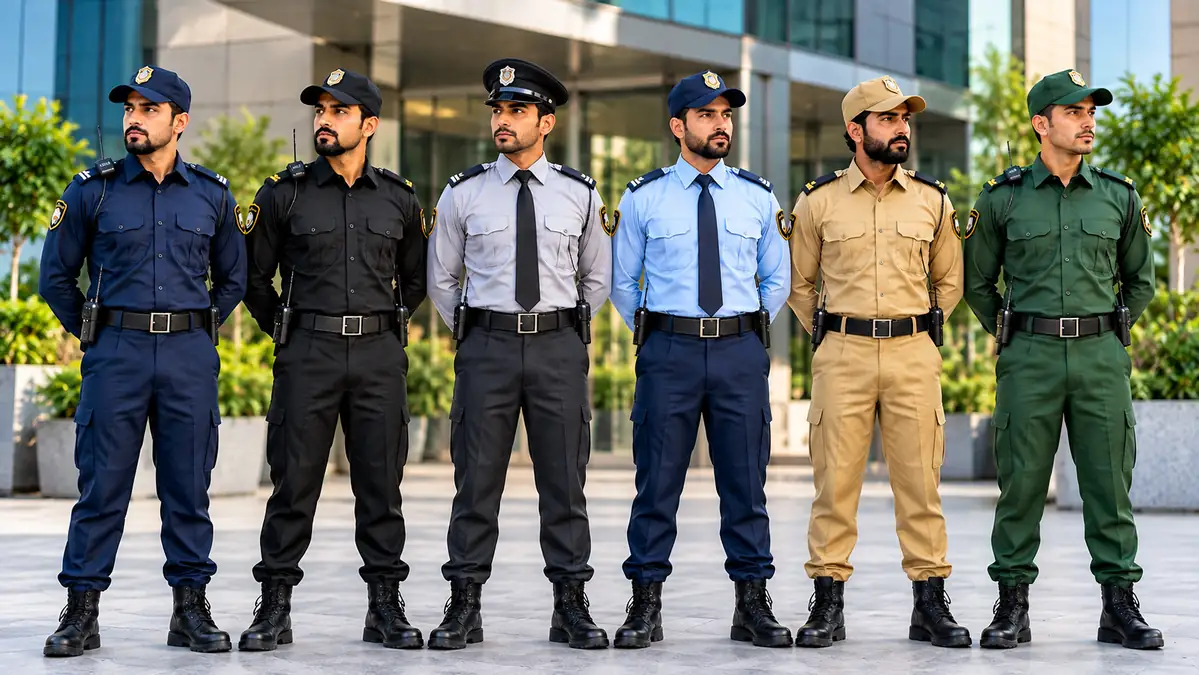
Choosing the right security guard uniform colours is an important decision for security companies, corporate offices, residential societies and industrial facilities. A well-designed uniform helps identify security personnel, creates a professional appearance, and makes guards easier to recognise by employees, visitors and customers.
Common security guard uniform colours include navy blue, black, grey, light blue, khaki and green. The right choice depends on the organisation’s branding, working environment, visibility requirements, and the responsibilities of security personnel.
This guide explains popular security guard uniform colours, practical colour combinations, standard dress codes, and the essential items included in a complete security guard uniform kit. It also helps security companies in Pakistan plan uniforms according to their operational requirements.
What Colours Do Security Guards Wear?
Security guards commonly wear navy blue, black, grey, light blue, khaki, and green uniforms. Navy blue and black are popular for corporate and private security teams, while grey, light blue and khaki offer alternative professional appearances. Green may be selected for outdoor sites or specific organisational branding.
There is no single universal colour requirement for every security company. The appropriate colour depends on company policy, client requirements, local regulations, and the environment in which guards work.
Why Do Security Guards Wear Uniforms?
Security guards wear uniforms to make their role identifiable, maintain a consistent professional appearance, and help people distinguish authorised security personnel from other staff and visitors.
A properly designed uniform serves several practical purposes:
- Easy identification: Employees, visitors, and customers can recognise security personnel.
- Professional appearance: Matching uniforms create a consistent image across security teams.
- Authority and recognition: A clear uniform design helps communicate the guard’s official role.
- Organisational identity: Company logos, badges and name plates help distinguish one security provider from another.
- Operational consistency: Standardised clothing makes it easier to manage teams across multiple locations.
- Workplace suitability: Appropriate fabrics and accessories support comfort and movement during duty.
A uniform should support security operations rather than simply look attractive. Its design should reflect the location, duties, and practical needs of the guards.
Popular Security Guard Uniform Colours and Their Uses
Security guard uniform colours can influence how a team is visually perceived. However, colour associations are not universal rules. Companies should consider their brand identity, client expectations, and working conditions before selecting a colour.
1. Navy Blue Security Guard Uniforms
Navy blue is a popular choice for corporate security teams, banks, offices, commercial buildings, and private security companies.
It creates a formal and coordinated appearance and works well with white, light blue, and grey details. Companies can also add embroidered logos, shoulder badges, and name plates to distinguish their personnel.
Recommended for: Corporate offices, banks, residential societies, commercial buildings and private security agencies.
2. Black Security Guard Uniforms
Black security uniforms are often selected for private security teams, events and assignments where a smart, formal appearance is preferred.
Black shirts, trousers and jackets can be combined with contrasting badges, embroidered logos or reflective details where appropriate.
For outdoor duties in hot weather, companies should carefully consider fabric weight, breathability and the amount of time guards spend in direct sunlight.
Recommended for: Private security companies, event security, selected corporate environments and indoor assignments.
3. Grey Security Guard Uniforms
Grey is a versatile option for organisations that want a professional appearance without choosing a very dark uniform.
Light grey shirts can be paired with charcoal or black trousers, while darker grey garments can be used for a coordinated uniform set.
Grey also works well with navy blue, black and white branding elements.
Recommended for: Commercial buildings, shopping centres, offices and facility management teams.
4. Light Blue Security Guard Uniforms
Light blue shirts offer a clean and distinctive appearance, particularly in customer-facing environments.
They can be paired with navy blue or black trousers and a matching cap. Companies may also use darker shoulder panels or contrasting collars to create a consistent design.
Recommended for: Reception security, corporate offices, commercial buildings and customer-facing assignments.
5. Khaki Security Guard Uniforms
Khaki is an established uniform colour that can be suitable for outdoor and operational environments.
Khaki shirts and trousers can be combined with dark brown, black or olive accessories. The colour and fabric should be selected according to the working environment and the company’s uniform policy.
Recommended for: Outdoor security assignments, selected industrial sites and organisations that prefer a traditional uniform appearance.
6. Green Security Guard Uniforms
Green uniforms can help create a distinctive identity for security teams working in outdoor environments or locations with specific organisational branding.
Different shades, including olive and dark green, can be paired with black or khaki trousers.
Recommended for: Residential communities, outdoor facilities, parks and site-specific security teams.
Security Guard Uniform Colour Combinations
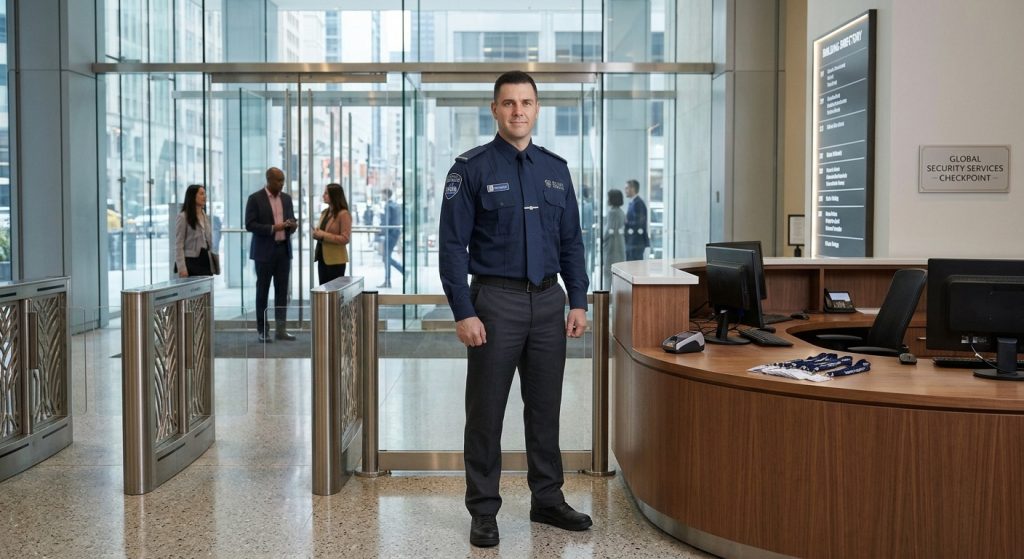
Selecting a suitable colour combination is just as important as choosing the main uniform colour. Shirts, trousers, caps, jackets, and accessories should create a consistent appearance.
The following combinations are practical design suggestions rather than mandatory uniform standards.
| Environment | Suggested Shirt Colour | Suggested Trouser Colour | Design Consideration |
|---|---|---|---|
| Banks and corporate offices | Light blue or navy | Navy or black | Formal and consistent appearance |
| Residential societies | Navy blue | Black or navy | Easy identification across teams |
| Shopping malls | Grey or light blue | Black | Professional customer-facing appearance |
| Industrial facilities | Navy or grey | Dark grey or navy | Practical fabric and site suitability |
| Outdoor security | Khaki or green | Matching dark trousers | Suitable for outdoor working conditions |
| Event security | Black | Black | Consistent appearance for event teams |
| Construction sites | Navy or grey | Dark work trousers | Consider additional high-visibility clothing where risk assessment requires it |
Before finalising a combination, security companies should check the client’s branding requirements and ensure that the uniform does not create confusion with emergency services or other authorised personnel.
What Is a Security Guard Uniform Dress Code?
A security guard uniform dress code is a set of clothing, identification, and appearance requirements established by a security company or its client. It defines what guards must wear while on duty, including shirts, trousers, footwear, badges and approved accessories.
A standard dress code may include:
- A company-approved security shirt.
- Matching or contrasting trousers.
- An approved cap or headwear.
- A visible company badge or identification.
- A nameplate, where required.
- Suitable footwear for the duty environment.
- An approved jacket or outer layer for colder conditions.
- Additional safety equipment where the job risk assessment requires it.
Security companies should document their uniform policy so that employees across different shifts and locations follow the same standards.
What Is Included in a Complete Security Guard Uniform Kit?
A complete security guard uniform kit includes the clothing and identification items required for the guard’s assigned duties. The exact kit varies by company, location, season, and operational responsibilities.
| Uniform Item | Purpose |
|---|---|
| Security shirt | Main upper-body uniform |
| Security trousers | Comfortable and practical lower-body clothing |
| Security cap | Consistent team appearance and identification |
| Uniform jacket | Additional layer for cold or outdoor conditions |
| Belt | Supports the uniform and approved accessories |
| Company badge | Displays organisational identity |
| Name plate | Identifies individual personnel |
| Suitable footwear | Supports comfort and safe movement |
| Reflective vest or jacket | Improves visibility when required by site conditions |
Security Guard Shirts
Security shirts should provide a professional appearance while allowing guards to move comfortably during duty.
Common design options include short-sleeved and long-sleeved shirts, button-front designs, chest pockets, shoulder epaulettes, and embroidered company logos.
The final design should reflect the company’s uniform policy and the operational requirements of the security team.
Security Guard Trousers
Security trousers should allow comfortable movement, particularly for guards who spend long periods standing, walking or conducting patrols.
Companies should consider fabric durability, stitching, pocket placement, waistband comfort and the overall fit before ordering trousers in bulk.
Security Guard Caps
Caps help create a consistent appearance and can provide some protection from direct sunlight during outdoor assignments.
A cap can include an embroidered company logo or approved identification detail. Its colour should coordinate with the shirt and trousers.
Security Jackets and Outerwear
Security jackets are useful for guards working during colder weather, night shifts, or outdoor assignments.
Companies can choose matching jackets, lightweight outerwear, ear protection, or other suitable garments according to the season and working environment.
Badges, Name Plates and Identification
Badges and name plates help identify security personnel and distinguish them from other workers.
Their design, placement and wording should follow company policy and any applicable client or local requirements.
Footwear and Approved Accessories
Suitable footwear is important for guards who walk, stand, or patrol for extended periods.
Additional accessories should only be included when they are authorised and relevant to the assigned role. A uniform should not contain unnecessary equipment that interferes with movement or safety.
How to Choose the Right Security Guard Uniform Colours
Security companies should evaluate the working environment, brand identity, job responsibilities and practical requirements before selecting uniform colours.
Consider these six steps:
1. Identify the working environment
Determine whether guards will work in offices, residential societies, shopping centres, industrial facilities, construction sites, or outdoor locations. Different environments may require different uniform designs.
2. Consider company branding
Choose colours that complement the company’s visual identity. Logos, badges and name plates should remain visible against the selected fabric colour.
3. Define the uniform dress code
Decide which items are mandatory, including shirts, trousers, caps, jackets and identification. Maintain a consistent standard across all locations.
4. Select suitable fabrics
Consider cotton, poly-cotton blends, twill or ripstop fabrics according to the expected duty conditions. Compare fabric weight, breathability, durability, and maintenance requirements before placing an order.
5. Evaluate visibility and safety
If guards work near moving vehicles, loading areas, construction activity, or other hazards, assess whether additional high-visibility clothing is necessary. Select such clothing according to the relevant risk assessment and applicable safety requirements.
6. Approve a sample before bulk production
Review the colour, fabric, sizing, stitching, logo placement, and overall fit before confirming a large uniform order. Sample approval helps reduce inconsistencies across the final batch.
Which Fabric Is Best for Security Guard Uniforms?
The best fabric for security guard uniforms depends on the working environment, expected duty hours, weather conditions, maintenance requirements, and budget.
Common fabric options include:
- Cotton: A natural fabric option that can be suitable where comfort and breathability are priorities.
- Poly-cotton: A blended fabric that combines cotton and polyester characteristics. Its performance depends on the actual fabric composition and construction.
- Twill: A fabric weave commonly used in workwear because of its structured appearance.
- Ripstop: A reinforced fabric construction designed to help limit the spread of small tears.
Companies should compare fabric specifications and request samples rather than selecting material based on its name alone.
Security Uniforms for Industrial and Outdoor Sites
Security guards working in industrial facilities, warehouses, construction sites, and outdoor locations may face different conditions from guards working in offices or reception areas.
Their uniforms should be selected according to the site environment and job responsibilities.
For example, industrial sites may require durable clothing, practical pockets, and suitable outerwear. Where a risk assessment identifies a need for enhanced visibility, additional high-visibility garments may be appropriate.
High-visibility clothing is not simply a matter of choosing a bright colour. Relevant standards, such as ISO 20471, address requirements involving fluorescent materials, retroreflective materials, material areas and placement. Whether a garment needs to meet a particular standard depends on the identified risk and applicable workplace requirements.
For industrial workwear options, explore our workwear and industrial uniforms.
For construction-related requirements, you can also view our construction uniforms.
Security Guard Uniform Requirements for Women
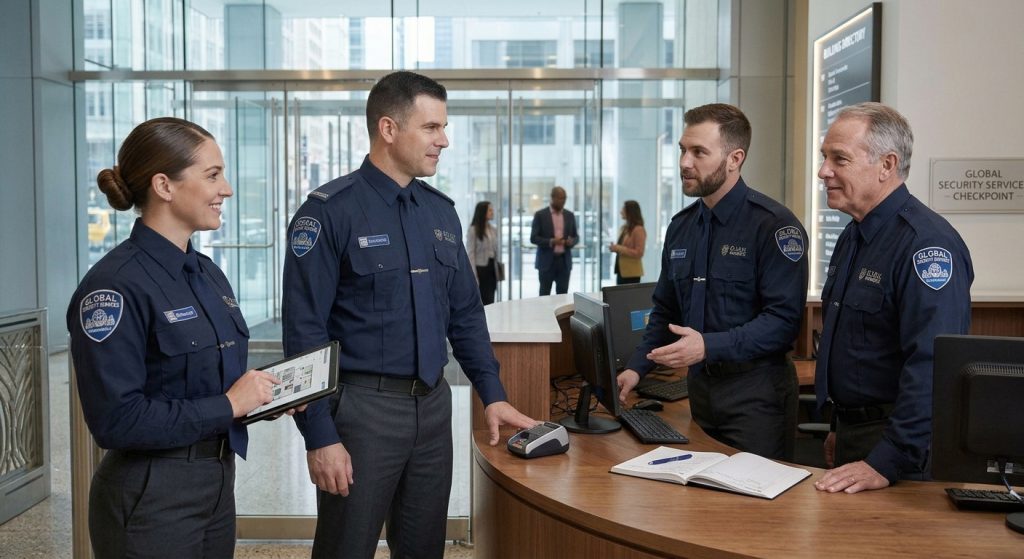
Security companies should also consider the fit and practical requirements of female security personnel when developing a uniform policy.
Uniform options should provide appropriate sizing, comfortable movement, and consistent company identification. Shirts, trousers, jackets, and other garments should be available in suitable fits rather than relying on a single standard pattern for every employee.
The design should maintain a consistent organisational appearance while accommodating the needs of individual team members.
Security Guard Uniform Bulk Ordering Checklist
Before ordering security guard uniforms in bulk, procurement managers should confirm the following details:
| Requirement | What to Confirm |
|---|---|
| Uniform colour | Approved shirt, trouser and jacket colours |
| Design | Final design and approved branding |
| Fabric | Material composition, weight and construction |
| Sizes | Individual size measurements |
| Quantity | Total quantity and size-wise breakdown |
| Logo | Embroidery or printing requirements |
| Identification | Badge and nameplate specifications |
| Accessories | Caps, belts, jackets and other approved items |
| Samples | Approval of fabric and finished sample |
| Quality | Stitching, finishing and size consistency |
| Delivery | Agreed production and delivery schedule |
For large teams, a size-wise employee list and an approved sample can make the ordering process more organised.
Security Uniform Manufacturing and Supply in Rawalpindi and Islamabad
Security companies need uniforms that reflect their identity while meeting the practical requirements of their teams.
Saad Enterprises provides uniform manufacturing and supply services for businesses and organisations in Rawalpindi and Islamabad. Companies planning security uniforms can discuss their preferred colours, designs, fabric options, branding requirements, and quantities before confirming an order.
Explore our security uniform manufacturing and supply page to learn more about our security uniform range.
For other operational clothing requirements, you can also explore our coverall uniform range.
To discuss your requirements, contact Saad Enterprises.
Frequently Asked Questions About Security Guard Uniform Colours and Kits
What is the most common security guard uniform colour?
Navy blue and black are commonly selected for security uniforms. However, grey, light blue, khaki and green are also used depending on company branding, working environments and client requirements.
What colours do private security guards wear?
Private security guards may wear navy blue, black, grey, light blue or other company-approved colours. There is no single universal colour for every private security organisation.
Why do security guards wear black uniforms?
Some security companies select black uniforms for a coordinated and formal appearance. However, fabric weight, weather, and outdoor working conditions should be considered before choosing black clothing for regular outdoor duty.
What is the best colour combination for security uniforms?
Navy blue shirts with black or navy trousers are a practical option for many corporate environments. Other combinations should be selected according to the client’s branding and operational requirements.
What is included in a security guard uniform set?
A standard security guard uniform set may include a shirt, trousers, cap, belt, nameplate, and suitable footwear. Jackets and reflective clothing may be added when required.
What is a security guard uniform dress code?
It is a company- or client-approved standard that defines the clothing, identification, accessories, and appearance expected from guards while on duty.
Do security guards need reflective jackets?
Not every security guard requires a reflective jacket. It may be necessary when guards work near vehicles, construction activity, or other hazards where a risk assessment identifies a visibility requirement.
Can security companies customise uniform colours and logos?
Yes. Uniform designs can be planned around company-approved colours, logos, identification and garment requirements. The final specifications should be confirmed before bulk production.
How should a company order security guard uniforms in bulk?
Prepare the required quantities, size breakdown, preferred colours, fabric specifications and logo details. Approve a sample before confirming bulk production to maintain consistency.
Final Thoughts
The right security guard uniform colours and kit depend on the organisation’s identity, working environment and operational requirements. Navy blue, black, grey, light blue, khaki and green each offer different design possibilities.
A complete uniform should combine suitable shirts, trousers, caps, jackets, identification, and footwear. Security companies should also consider fabric performance, employee comfort, visibility requirements, and consistent sizing before placing bulk orders.
For businesses in Rawalpindi and Islamabad planning customised security uniforms, Saad Enterprises can help discuss uniform designs, colours, and manufacturing requirements.


