
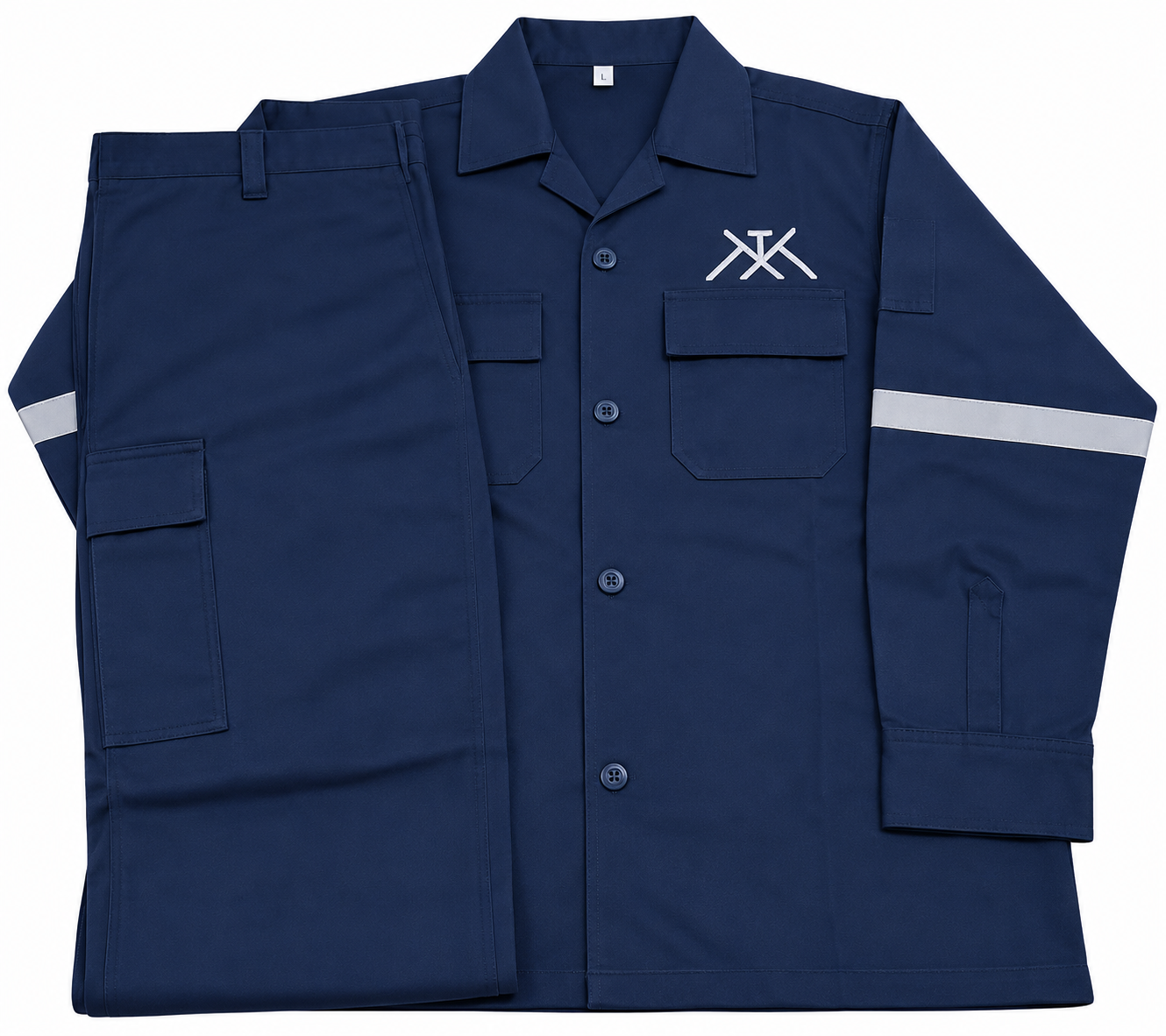
A mechanic’s uniform takes more punishment than almost any other workwear: engine oil, grease, brake dust, sharp edges and a hot workshop for most of the year. Workshops and car dealerships that get it right have a team that looks professional to customers and lasts a full year in the same set.
This guide covers the choice between coveralls and two-piece sets, the fabrics and colours that work, and the details mechanics actually use. For bulk workwear, see our page on industrial workwear and worker uniforms.
Coverall or shirt and trousers?
| Option | Best for | Pros | Cons |
|---|---|---|---|
| Coverall (dangri) | Under-car, engine and body work | Full protection; no gap at the waist | Warmer in summer; harder to take off |
| Shirt and trousers | Service bays, quick jobs, tyre and battery shops | Cooler; top and bottom can be replaced separately | Shirt can ride up when bending |
| Shirt and trousers with an apron | Parts counters and lighter work | Smart for customers; apron takes the dirt | Less protection for heavy jobs |
Many workshops issue both: coveralls for technicians on heavy jobs, and a shirt and trousers set for the rest. Our page on coverall uniforms covers the coverall options.
Fabric guide for mechanic uniforms
| Fabric | Typical weight | Feel and care | Best for |
|---|---|---|---|
| 100% cotton drill or twill | 220–260 GSM | Breathable and soft; comfortable in heat | Workshops and summer use |
| 65/35 poly-cotton twill | 220–250 GSM | Strong, keeps its colour, easy to wash | Dealerships and busy service centres |
| Heavy poly-cotton drill | 260–280 GSM | Toughest wear, holds its shape | Heavy repair and body shops |
For a full comparison of coverall fabrics, read our guide to the best fabric for coveralls.
Colours that hide grease
Navy, charcoal grey and black hide oil and grease best, and still look smart to customers. Many dealerships use a dark shade for technicians and a lighter shirt in the same colour family for service advisors at the front desk, so customers can tell the two apart.
Details mechanics actually use
- Tool pockets: chest pockets with flaps, and a side leg pocket for a small tool or a phone.
- Pen and gauge slot: a narrow pocket on the sleeve or chest.
- Strong seams: double-needle seams and bar-tacks at pocket corners, where uniforms usually tear first.
- Reflective tape: on the back and sleeves for staff who work in driveways, petrol stations or roadside recovery.
- Name and logo: the workshop logo on the chest and the mechanic’s name above the pocket, so customers know who worked on their car.
Dealership technicians and service advisors
Car dealerships usually want two looks in one colour scheme: a coverall or work shirt and trousers for technicians in the bay, and a smart shirt or polo with trousers for service advisors who meet customers. Keeping the same colours and logo across both makes the dealership look like one team.
Washing grease out of work uniforms
Wash work uniforms separately from home clothes, in warm water with a strong detergent. Treat heavy grease spots before the wash, and avoid fabric softener, which can hold oil in the fibres. Poly-cotton twill keeps its colour best through frequent washes.
How many sets each mechanic needs
Three sets per mechanic is the usual minimum: one worn, one in the wash and one spare for the day a uniform gets soaked in oil. Heavy repair shops often add a fourth.
Ordering mechanic uniforms in Rawalpindi and Islamabad
Workshops and dealerships in the twin cities, from I-9 and I-10 to Rawalpindi’s industrial areas, can see fabric swatches and samples at our factory near I-10, IJP Road, Rawalpindi, or at our Blue Area office in Islamabad. We make work uniforms from 30 sets per design, in sizes S to 4XL.
Winter workwear for workshops
Workshops in Rawalpindi and Islamabad are cold on winter mornings, and mechanics often pull on whatever jacket they own. A work jacket in the uniform colour, with the workshop logo and reflective tape, keeps the team looking the same all year.
Choose a jacket with a zip front and closed cuffs that won’t catch on engine parts, and make sure it is short enough not to drag when the mechanic kneels or slides under a car.
Frequently asked questions
What should a mechanic wear at work?
A coverall or a two-piece set of work shirt and trousers in strong twill, in a dark colour that hides grease, with the workshop’s logo and reflective tape if they work near traffic.
Is a coverall or a shirt and trousers better for mechanics?
Coveralls give full protection for under-car and engine work. A shirt and trousers set is cooler, easier to take off and suits service advisors and lighter jobs.
Which fabric is best for mechanic uniforms?
Cotton drill or twill (220–260 GSM) for workshops and summer, and 65/35 poly-cotton twill (220–250 GSM) when uniforms are washed often and need to keep their colour.
What colours hide grease best?
Navy, charcoal grey and black hide grease and oil stains best. Use a lighter shade only for service advisors who don’t work on vehicles.
Need uniforms for your workshop?
WhatsApp +92 331 5050974 with your team size, the work you do and your logo. We will suggest the right fabric and send a sample plan.