
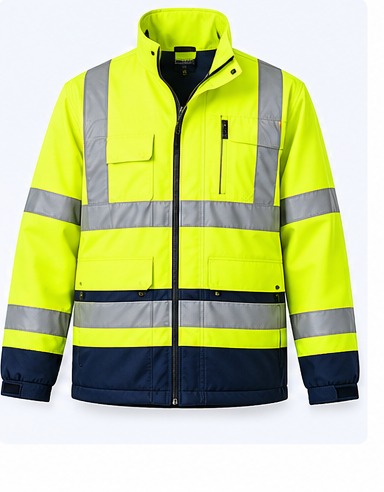
Key takeaway: Safety vests we checked in Pakistan were listed from about Rs 554 for a basic net vest to Rs 9,408 for a pocketed vest. The gap comes from fabric, reflective tape area, pockets, branding and whether a hi-vis class is claimed. For 50 or more vests, our factory quotes per vest on a written specification: mesh or tricot, tape layout, colours and logo.
In this guide: what it costs · price drivers · fabric · hi-vis classes · reflective tape · bulk quote checklist · FAQs
Search results for this topic are mostly single-vest shop listings. They show a price but rarely state the fabric weight, the tape area or the standard. A buyer ordering for a site, a security team or a sweeping crew needs those details more than the price. This guide covers what drives the cost of a safety vest and what to put in a bulk request. Our construction uniforms page lists the full site kit.
How much does a safety vest cost in Pakistan?
It depends on the vest. A basic polyester net vest was listed near Rs 554, while a multi-pocket vest from another seller was listed at Rs 7,392 to Rs 9,408. Bulk factory prices are quoted per vest, because tape, fabric, logo and quantity change the figure. We checked these listings on 24 November 2026.
| Listing (checked 24 Nov 2026) | Listed price | What the page states |
|---|---|---|
| Silver String, blue net vest | Rs 554 | Polyester net, silver strips front and back; no standard named; ex-works, tax and freight excluded; prices last updated January 2023 |
| Powerhouse Express, Total TSP503 | Rs 950 (page also shows Rs 880) | Orange polyester tricot, 5 cm strip, says EN471 class 2; button marked discontinued |
| Silver String, multi-pocket vest | Rs 7,392 to Rs 9,408 (two colour versions) | Pockets and reflective tape; no GSM, tape spec or standard |
Two things stand out. The price range is more than 15 times wide, and the cheapest listing names no standard. Read these as single-piece retail prices, not bulk rates.
What decides the price of a safety vest?
Six things decide it: fabric, reflective tape, pockets and trim, colour, logo and quantity. A plain mesh vest with two stripes sits at the low end. A vest with pockets, bound edges, role colours and a printed back sits higher. Ask for each line in writing.
| Price driver | What to ask | Effect on cost |
|---|---|---|
| Fabric | Mesh or tricot, and the GSM | Tricot is smoother and takes a print better |
| Reflective tape | Width, number of bands, sewn or glued | More tape adds material and sewing time |
| Pockets and trim | ID, phone and radio pockets, bound edges | Each extra feature adds labour |
| Colour | Fluorescent yellow, orange or a role colour | Small runs of special colours can cost more |
| Logo | Print or embroidery, back and chest | Priced per vest, so it scales with headcount |
| Quantity | Price at 50, 100 and 300 vests | Setup cost spreads over more pieces |
Which fabric is best for a hi-vis vest: mesh or tricot?
It depends on the season and the logo. Fluorescent polyester mesh at 100 to 120 GSM is the lightest and coolest, so it suits summer sites. Fluorescent polyester tricot at 120 to 140 GSM has a smoother surface and takes a printed logo better. Both are fabrics we use for vests.
| Fabric | Weight | Best for | Trade-off |
|---|---|---|---|
| Polyester mesh | 100 to 120 GSM | Hot weather, outdoor crews | Open weave holds a printed logo less crisply |
| Polyester tricot | 120 to 140 GSM | Vests with a printed company logo | Slightly warmer than mesh |
Our site shirts and trousers use heavier cloth, such as poly-cotton twill, but vests use the two fabrics above. For the workwear layer underneath, see our guide to the best fabric for coveralls.
What do hi-vis Class 1, 2 and 3 mean, and does your site need one?
Classes describe how much high-visibility material a garment carries. Under EN ISO 20471, Class 3 needs the most and Class 1 the least. Your site, client or insurer decides whether a class is required. If it is, ask the supplier for the class and a test report before you order.
| EN ISO 20471 class | Minimum fluorescent background material | Minimum retroreflective material |
|---|---|---|
| Class 3 | 0.80 m² | 0.20 m² |
| Class 2 | 0.50 m² | 0.13 m² |
| Class 1 | 0.14 m² | 0.10 m² |
These figures come from the EU’s occupational safety agency summary of the standard (OSHwiki, checked 24 November 2026). The standard allows fluorescent yellow, orange-red or red as background colours. Reflective clothing for work is personal protective equipment in the EU, so a class claim needs a tested garment, not only a sewn-on stripe.
Our construction page does not state a class, and we make no class claim in this guide. If your site requires one, tell us before we quote so the specification can be checked against the requirement.
Why can a cheap vest fall short on reflective tape?
Because tape area adds up fast. Two thin stripes around the chest give far less reflective material than a class asks for. A vest that looks bright in daylight may still carry too little tape for night work, so count the area instead of trusting the photo.
Here is an illustration. Assume 5 cm wide tape, the width stated on one listing above, and a chest circumference of 1 metre. One band around the chest is 0.05 m². Two bands are 0.10 m², which is below the 0.13 m² retroreflective minimum for Class 2 before the placement rules even apply. A vest needs more bands, shoulder strips or both, and it still needs testing to carry a class.
Our tape is sewn on rather than glued, so it stays on through washing. Layouts can run across the chest, back, arms and legs. Ask any supplier whether the tape is sewn or glued, because glued tape can peel in the wash.
Can vests be colour-coded by role?
Yes. Many sites give labour one colour and supervisors another, for example yellow for labour and orange for supervisors. Company colours can also be used. Keep the code simple, write it down, and use the same shade on every reorder so crews can be told apart at a glance.
What should a bulk safety vest request include?
List the headcount, fabric, colours, tape layout, pockets, logo position, size plan and delivery date. Add the hi-vis class if your site requires one. A clear request lets the factory give a written price per vest that you can compare line by line.
| Specification line | What Saad Enterprises offers |
|---|---|
| Fabric | Fluorescent polyester mesh (100 to 120 GSM) or tricot (120 to 140 GSM) |
| Tape | Sewn-on reflective tape; layouts on chest, back, arms and legs |
| Construction | Bound edges; ID, phone and radio pockets on site kits |
| Colours | Fluorescent high-visibility colours, role colours or company colours |
| Size | Vests in free size; shirts and trousers in S to 4XL |
| Logo | Printed or embroidered in-house; usual layout is a printed back and an embroidered chest |
| Minimum order | 50 sets |
Need a quote? WhatsApp +92 331 5050974 with your worker count, items and logo, and we reply with options and a written price.
How do you inspect a vest sample?
Check the colour in daylight, then look at the tape, the edges and the logo. Wash it once and compare. Samples are the cheapest place to catch faults, so do not approve a bulk order from a photo alone.
- Colour: view the fluorescent shade outdoors, not only under shop lights.
- Tape: pull at the ends of each band and check the stitching.
- Edges: run a finger along the binding for loose threads.
- Fit: try the free size over a jacket and over a shirt.
- Logo: check the print or embroidery after one wash.
When is a factory order the wrong choice?
A factory order is the wrong choice for fewer than 50 pieces, for visitor vests needed this week, or for a one-day event. A hardware or safety shop is faster for those. A factory suits crews that need matching vests, role colours and repeat orders. The wholesale uniform buying guide explains minimums and sampling.
Vests often go with other crew gear. See our pages on security uniforms, industrial workwear and factory worker uniforms.
FAQs
What is the price of a safety vest in Pakistan?
Listings we checked on 24 November 2026 ranged from about Rs 554 for a basic net vest to Rs 9,408 for a pocketed vest. Bulk factory prices are quoted per vest on a written specification.
What is the minimum order for safety vests?
Our minimum order is 50 sets. For fewer vests, a safety shop or online store is the better option.
Can you print our company logo on safety vests?
Yes. Logos and company names can be printed or embroidered in-house. We recommend tricot fabric for printed logos.
Do hi-vis vests need a Class 1, 2 or 3 rating?
It depends on your site, client or insurer. Under EN ISO 20471 the classes set minimum areas of fluorescent and reflective material. If you need a class, tell us before we quote so the request is checked first.
Next step: send your worker count, vest style and logo on WhatsApp +92 331 5050974, or use the contact page, to request a free bulk quote.