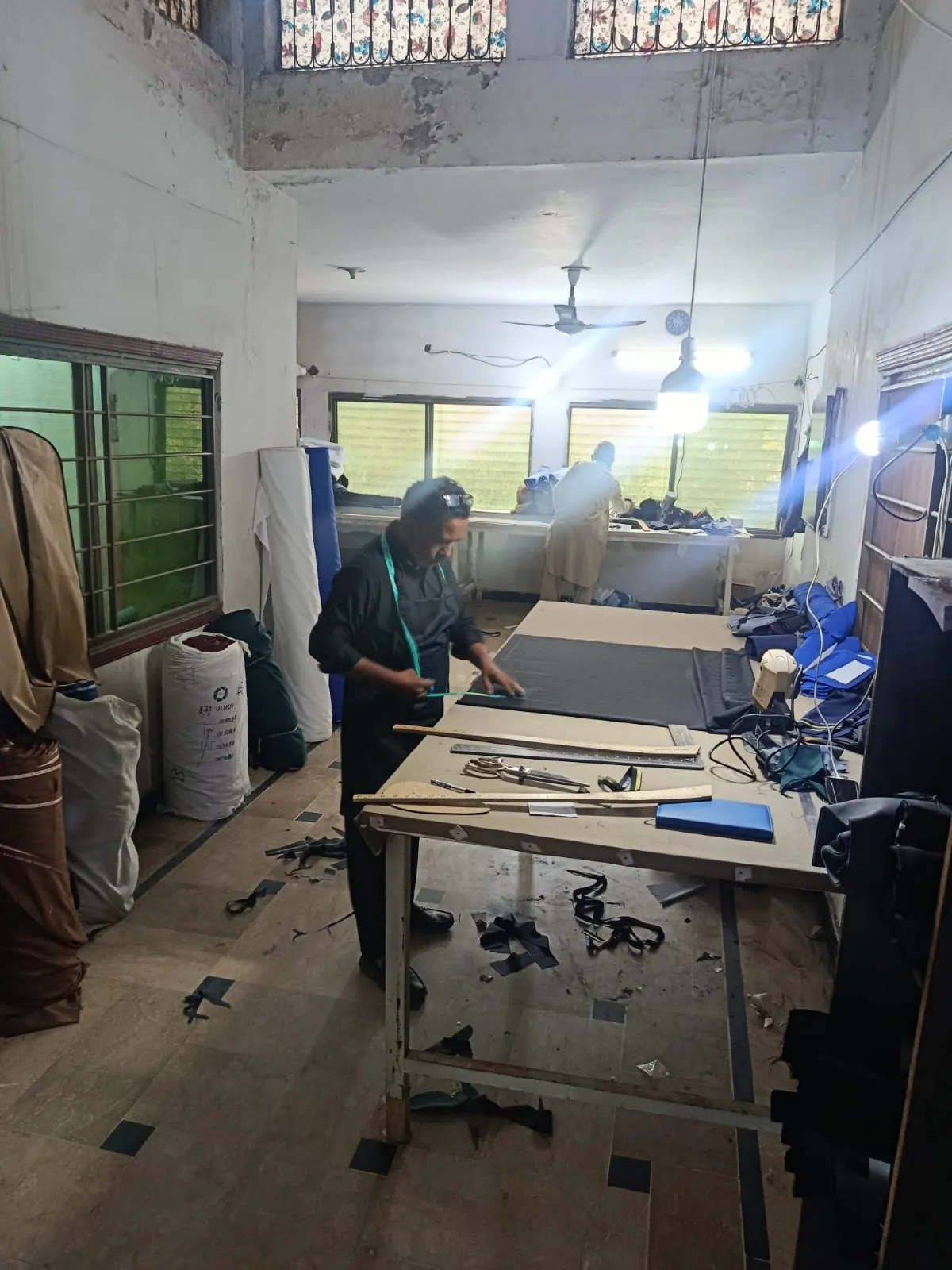
Key takeaway: A custom uniform order comes down to four decisions: fabric, colour, logo method and sizes. Settle each one in writing and approve a stitched sample before bulk production. At Saad Enterprises custom orders start at 50 sets, with embroidery and printing done in our own factory in Rawalpindi.
Custom uniforms are made to your design instead of taken from a shelf: your colour, your logo, your sizes. Most problems with custom orders come from decisions that were never written down. This guide walks through the four decisions in the order a factory needs them. We make custom uniforms at our factory, and you can see how we work on the uniform manufacturers in Rawalpindi page.
What does “custom uniform” actually mean?
A custom uniform is cut and stitched for one organisation. You choose the fabric, the colour, the design details and the logo, and the factory keeps that specification for repeat orders. It differs from ready-made stock, where you accept the shop’s cloth, colour and sizes and add a logo afterwards.
Which fabric should you choose for custom uniforms?
It depends on the job. Choose poly-cotton for daily staff uniforms that must hold colour and need little ironing. Choose cotton-rich cloth for hot kitchens and outdoor work. Choose twill for workwear that takes rough use, and pique knit for polo shirts.
| Fabric | Suits | Trade-off |
|---|---|---|
| Poly-cotton blend | Office, hotel, security and school uniforms | Easy care and holds colour, but less airy than cotton |
| Cotton or cotton-rich | Chef coats, hot workplaces | Breathes well, but creases and can shrink if not pre-treated |
| Twill | Coveralls, industrial workwear, trousers | Strong weave, but heavier to wear in summer |
| Pique knit | Polo shirts for staff and promotions | Smart and comfortable, but prints need the right method |
| Polyester | Sports kits, sublimated designs | Takes full-colour prints, but is warm for all-day indoor wear |
Ask the factory for the blend and the GSM in writing. GSM is the weight of the cloth in grams per square metre, and it lets you compare two quotes on equal terms. Our fabric guides go deeper: best fabric for coveralls and best fabric for medical scrubs.
How do you get the colour right?
Give the factory a physical reference, not a colour name. “Navy” from two suppliers will not match. Hand over a fabric piece, an old uniform or a brand colour code, approve a swatch in daylight, and keep one approved piece as your master for future orders.
If your uniforms must match last year’s batch, say so at the start. The factory then matches the old piece before any cloth is cut.
Which logo method is best: embroidery, screen print, DTF or sublimation?
It depends on the garment and the artwork. Embroidery suits shirts, polos, coats and caps where the logo should last as long as the garment. Screen printing suits large runs with one to three colours. DTF handles small, multi-colour detail. Sublimation works only on polyester.
| Method | Best for | Avoid when |
|---|---|---|
| Embroidery | Chest logos on shirts, polos, chef coats, lab coats, caps | The logo has very fine text or colour gradients |
| Screen printing | Large back prints and big quantities in few colours | You need many colours on a small order |
| DTF printing | Detailed multi-colour logos, smaller batches | The print area is very large on a garment worn in heat |
| Sublimation | All-over designs on polyester sports kits | The fabric is cotton or a dark colour |
A simple rule: stitched logos for uniforms people wear for a year or more, printed logos for event and promotional wear. All four methods are done in-house at our factory, so you can see the same logo in two methods on a test piece before you decide.
Not sure which method fits your logo? Send the artwork on WhatsApp +92 331 5050974 and we will suggest one.
How should you handle sizes for a whole team?
Collect sizes against the factory’s size chart, not by guessing small, medium and large. Ask for sample pieces in a few sizes, let staff try them, and record each person’s size against their name. Add a few spare sets in the most common sizes for new joiners.
- Get the size chart and two or three sample sizes.
- Let each staff member try a sample and note the size.
- Mark anyone who needs a special fit.
- Send one list: name, role, size, quantity.
- Order spare sets in your most common sizes.
What are the steps of a custom uniform order?
A custom order runs in six steps: brief, quote, sample, approval, production and delivery. The sample stage is where problems are cheap to fix, so do not skip it to save time. Changes after cutting cost cloth and days.
- Brief: item, fabric, colour reference, logo file, quantity and date needed.
- Quote: price per set for that exact specification.
- Sample: one stitched piece with the logo applied.
- Approval: wash the sample, check fit and colour, then sign off in writing.
- Production: cutting, stitching, branding and checking.
- Delivery: count the pieces by size against your list.
For pricing, minimums and samples in more detail, read the wholesale uniform buying guide.
What are the common mistakes with custom uniform orders?
The most common mistake is approving a design on screen and never seeing a stitched sample. The others are choosing fabric by price alone, sending a low-quality logo image, collecting sizes by guesswork, and ordering the exact headcount with no spare sets.
- Approving from a picture instead of a washed sample
- Comparing quotes that use different fabrics
- Sending a logo screenshot instead of the original artwork file
- No written colour reference
- No spare sets for new staff
When are custom uniforms not worth it?
Custom uniforms are not worth it for very small teams or one-day needs. Below 50 sets, a factory production run does not make sense, and ready-made pieces with a logo added locally will cost less. Our minimum order is 50 sets.
FAQs
What is the minimum order for custom uniforms?
At Saad Enterprises the minimum is 50 sets. This applies to custom designs with your fabric, colour and logo.
Can I see a sample before the bulk order?
Yes. We make a stitched sample with your logo, and bulk production starts after you approve it.
Which industries do you make custom uniforms for?
Schools, offices, hotels and restaurants, hospitals, security companies, factories and sports teams. See corporate uniforms, medical uniforms and industrial workwear.
Do you deliver custom uniforms across Pakistan?
Yes. Our factory is in Rawalpindi and we deliver nationwide. Buyers in Rawalpindi and Islamabad can visit to see fabric and samples.
Next step: send your item, quantity, colour reference and logo on WhatsApp +92 331 5050974, or use the contact page, to request a free bulk quote.