
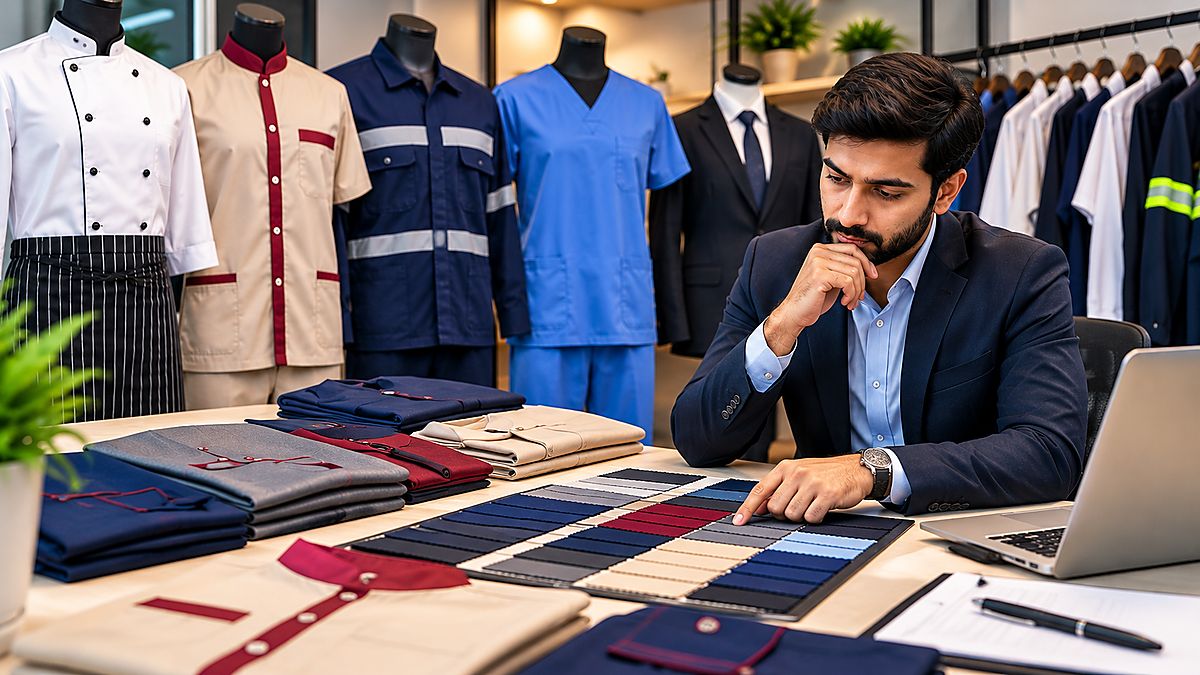
A bad uniform order usually shows up months later: shirts that faded after a few washes, a pocket seam that opened, or a second batch in a slightly different colour. By then, the invoice is paid.
This guide explains how to choose a uniform manufacturer in Pakistan using 10 checks you can make before you sign a bulk order. It is written from the factory side, by the team that cuts, stitches, and embroiders uniforms in Rawalpindi.
Short answer: choose a manufacturer that owns its factory, quotes fabric by blend and GSM, gives you a sample with your logo before bulk production, puts the delivery date in writing, and can match the same colour on your next order.
The 10 checks at a glance
Use this table on your first call with any supplier. One red flag isn’t always a deal-breaker, but three usually are.
| # | Check | What to ask | Red flag |
|---|---|---|---|
| 1 | Own factory | Can I visit where my order is made? | No address, or “we work with a partner unit” |
| 2 | Fabric spec | What is the blend, weave, and GSM? | “Good quality fabric” with no numbers |
| 3 | Colourfastness | Has this fabric been wash-tested? | No swatch to take away and test |
| 4 | Sample first | Will I approve a sample with my logo? | Bulk production starts straight after payment |
| 5 | Stitching | Where are the seams reinforced? | Single stitching at pockets and side seams |
| 6 | Sizing | Do you take measurements or give a size chart? | Sizes only as S, M, L with no measurements |
| 7 | Minimum order | Is the minimum per design or per order? | A minimum far above what you need |
| 8 | Delivery date | Will you write the date on the quote? | “Jaldi ho jayega” and nothing in writing |
| 9 | Branding | Is embroidery or printing done in-house? | Logo work sent out to another shop |
| 10 | Proof and after-sales | Who can I call as a reference? What if pieces are faulty? | No references and no replacement policy |
The 10 checks in detail
1. Does the supplier own a factory, or resell?
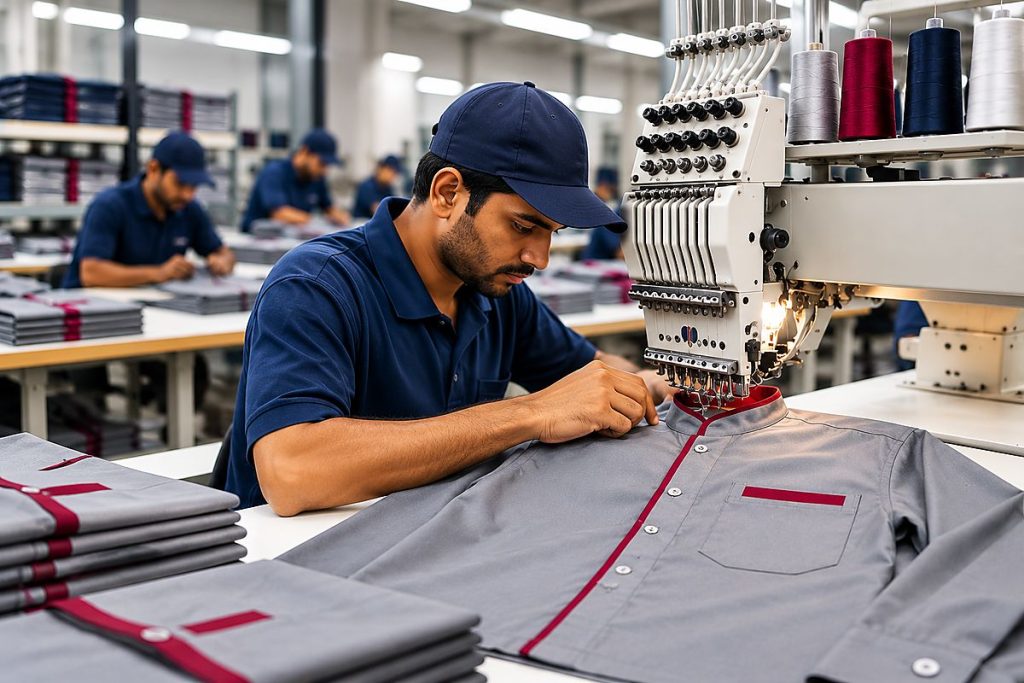
A real uniform manufacturer can show you cutting, stitching, and finishing in one place. A trader buys from a factory and adds a margin, and has less control over your fabric and delivery date. Ask to visit, or at least ask for a live video of the production floor.
2. Is the fabric quoted by blend, weave, and GSM?
“Poly-cotton” is not a specification. A proper quote names the blend (for example, 65/35 poly-cotton), the weave (twill, poplin or pique), and the weight in GSM. Ask for a swatch of the exact fabric to keep, so you can compare it with what arrives.
3. Will the colour survive washing?
Colourfastness decides how long a uniform looks new. Labs test it with ISO 105-C06, the standard test for colour fastness to laundering. At minimum, wash a swatch five times with your usual detergent and compare it with an unwashed piece before you approve the fabric.
4. Will you approve a sample with your logo first?
A good manufacturer makes one sample set, with your logo and in your colours, before cutting the bulk order. Keep the approved sample. It becomes the reference if anything in the bulk delivery doesn’t match.
5. Is the stitching reinforced where uniforms fail?
Uniforms fail at the same places: pocket corners, belt loops, crotch seams, and side seams. Look for bar-tacks at pocket corners and belt loops, and double or triple-needle stitching on seams that take strain. Compare the sample’s stitching with a cheaper quote side by side.
6. How will sizing be handled?
Ask whether the manufacturer will take measurements at your site or give you a size chart with measurements in inches. For schools and large staff teams, order 5–10% extra pieces in the most common sizes to cover new joiners and mistakes.
7. Does the minimum order fit your size?
Check whether the minimum order is counted per design, per colour, or per total order. Large export units often need high quantities. A factory with a lower minimum suits a school, clinic or office that needs 30 to 300 sets rather than thousands.
8. Is the delivery date in writing?
A delivery date matters most before a new school session or a hotel opening. Ask for the date on the quote, and ask what happens if it slips. A supplier who won’t write a date down is telling you something.
9. Is the branding done in-house?
Embroidery, screen printing, DTF, and sublimation done under the same roof keep your logo consistent and save days. When logo work is sent to another shop, delays and colour mismatches are more likely.
10. Can they prove past work, and fix faulty pieces?
Ask for one or two clients you can call, and check the supplier’s Google reviews and address. Ask, before you pay, what happens to faulty pieces: repair, replacement, or credit. Get the answer in the quote.
How to compare uniform quotes like for like
A price per set means nothing until the quotes describe the same product. Before comparing prices, make sure every quote lists:
- Fabric blend, weave and GSM
- Pieces in each set (for example, two shirts, one trouser, one sweater)
- Size range, and whether larger sizes cost more
- Logo method, size, and position
- Sample cost, and whether it is adjusted against the order
- Delivery date and payment terms
Factory, trader or online printer?
Each type of supplier suits a different order. For uniforms worn every day, a factory is usually the safer choice.
| Supplier type | Best for | Watch out for |
|---|---|---|
| Manufacturer with its own factory | Daily-wear uniforms, repeat orders, custom designs | Minimum order quantities |
| Trader or bazaar shop | Small, urgent orders of standard designs | Added margin, less control over fabric and dates |
| Online printer | Event T-shirts and promotional wear | Limited fabric choice, printed logos that fade faster |
How Saad Enterprises handles these checks
Saad Enterprises is one of the uniform manufacturers in Rawalpindi that owns its factory, on IJP Road opposite I-10. You can visit, see the cutting and stitching floor, and handle fabric swatches before you order.
We quote fabric by blend and GSM, make a sample with your logo before bulk production, and do embroidery, screen printing, DTF, T,, F and sublimation in-house. Our minimum order starts at 30–50 sets, and we have offices in Islamabad and Faisalabad, as well as the Rawalpindi head office.
For fabric advice by sector, see our guide to the best fabric for medical scrubs, our chef coat and restaurant uniform fabric guide, and our office boy uniform guide. To see everything we make, browse our full product range, or read more about us as uniform manufacturers in Pakistan.
Frequently asked questions
What should I ask a uniform manufacturer before ordering?
Ask for the fabric blend and GSM, a sample with your logo before bulk production, the delivery date in writing, the minimum order, and whether embroidery and printing are done in-house.
How can I tell if a uniform supplier is a real manufacturer?
Ask to visit the factory. A real manufacturer can show you cutting, stitching, and embroidery in one place, quote fabric by GSM, and can tell you exactly where your order will be made.
What minimum order do uniform manufacturers in Pakistan ask for?
It depends on the factory and the design. Saad Enterprises starts from 30–50 sets per order, which suits schools, clinics, and offices that need hundreds of pieces rather than thousands.
How do I make sure a re-order matches the first batch?
Keep the approved sample and a fabric swatch, and ask the manufacturer to write the fabric code, shade, and GSM on your invoice. Re-order from the same manufacturer and mention those details.
Comparing uniform suppliers? Visit our factory in Rawalpindi or request a free bulk quote. You can also WhatsApp +92 331 5050974 for fabric swatches and a sample.


