
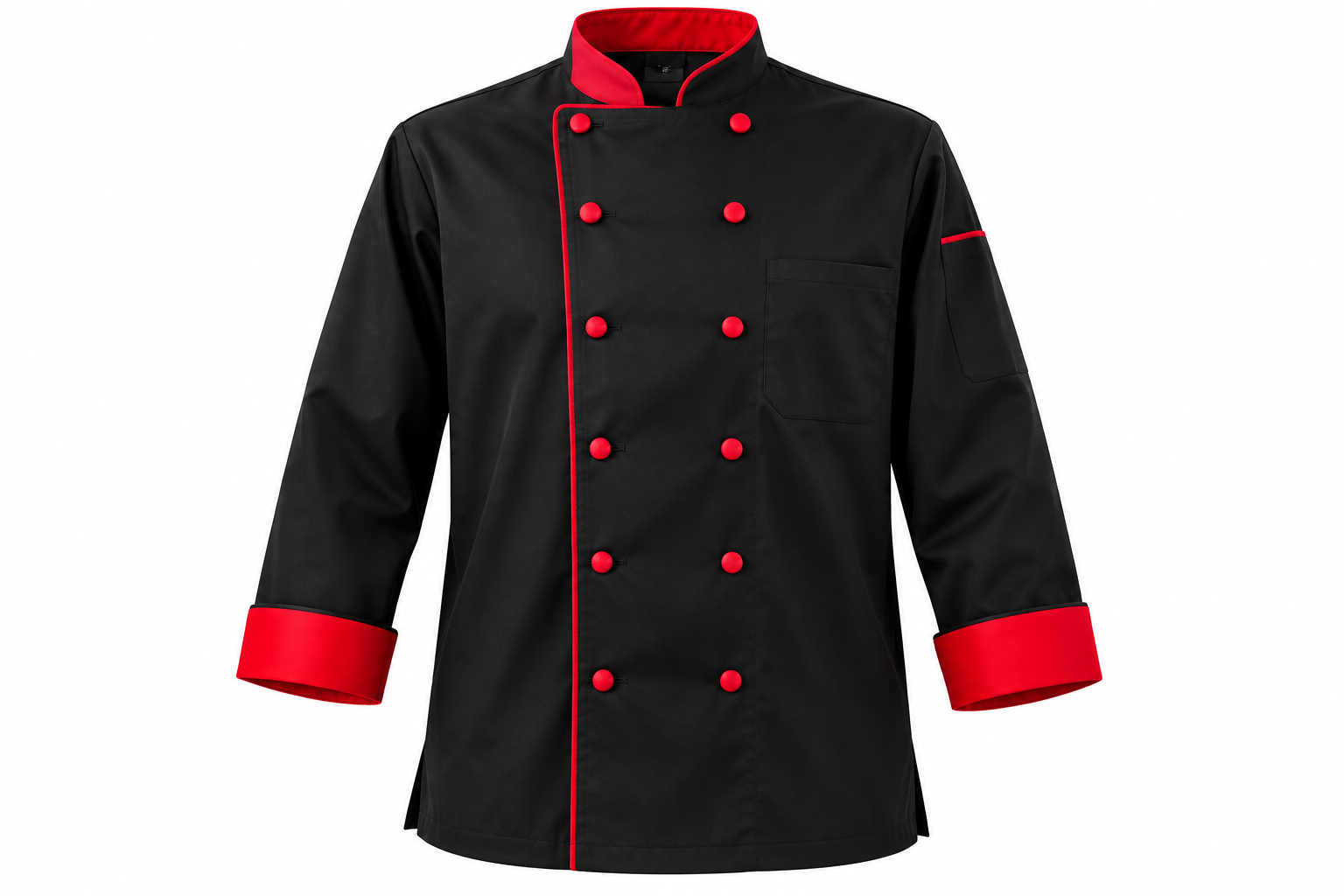
The best fabric for chef coats is a cotton-rich drill or 65/35 poly-cotton twill at 180–220 GSM. It breathes in a hot kitchen, protects against splashes, and survives daily washing. Waiters and front-of-house staff need something different: lighter poly-cotton shirts with poly-viscose waistcoats that stay smart through a long service.
We make chef coats, waiter uniforms and aprons for restaurants, cafes and hotels at our factory near I-10, Rawalpindi. This guide is what we walk restaurant owners through before a bulk order: the right fabric for each role, what works near a tandoor, and how to keep uniforms looking clean.
Which fabric for which role
| Role and item | Recommended fabric | Typical weight | Why it works |
|---|---|---|---|
| Chef coat | Cotton-rich drill or 65/35 poly-cotton twill | 180–220 GSM | Breathes, blocks splashes, takes hot washing |
| Kitchen trousers | Poly-cotton twill, elastic or drawstring waist | 200–240 GSM | Comfortable on long shifts, hides spills in dark colours |
| Bib aprons (kitchen) | Heavy cotton canvas or poly-cotton drill | 220–300 GSM | Takes heat, grease and constant washing |
| Waist aprons (waiters) | Poly-cotton drill or denim | 200–260 GSM | Holds shape, pockets for order pads and pens |
| Waiter shirts | Poly-cotton poplin, or stretch poplin | 110–135 GSM | Light, cool, looks crisp all evening |
| Waistcoats and host uniforms | Poly-viscose suiting | 220–280 GSM | Smart drape, wrinkle-resistant |
| Kitchen helpers and dishwashers | Poly-cotton twill in a dark colour | 180–220 GSM | Durable and easy to keep looking clean |
Cotton or polyester near the tandoor?
This matters more in Pakistani kitchens than almost anywhere else. Tandoors, open grills, and karahi stations put cooks right next to open flame.
Polyester melts when it catches fire, and molten fabric sticks to skin. Cotton chars instead of melting. That makes it the safer choice for cooks working at the tandoor, grill, or open burners. For these stations, choose 100% cotton or a cotton-rich blend (60% cotton or more).
For prep, pastry, and cold kitchens, a 65/35 poly-cotton is fine. It costs less, creases less,s and lasts longer through washing.
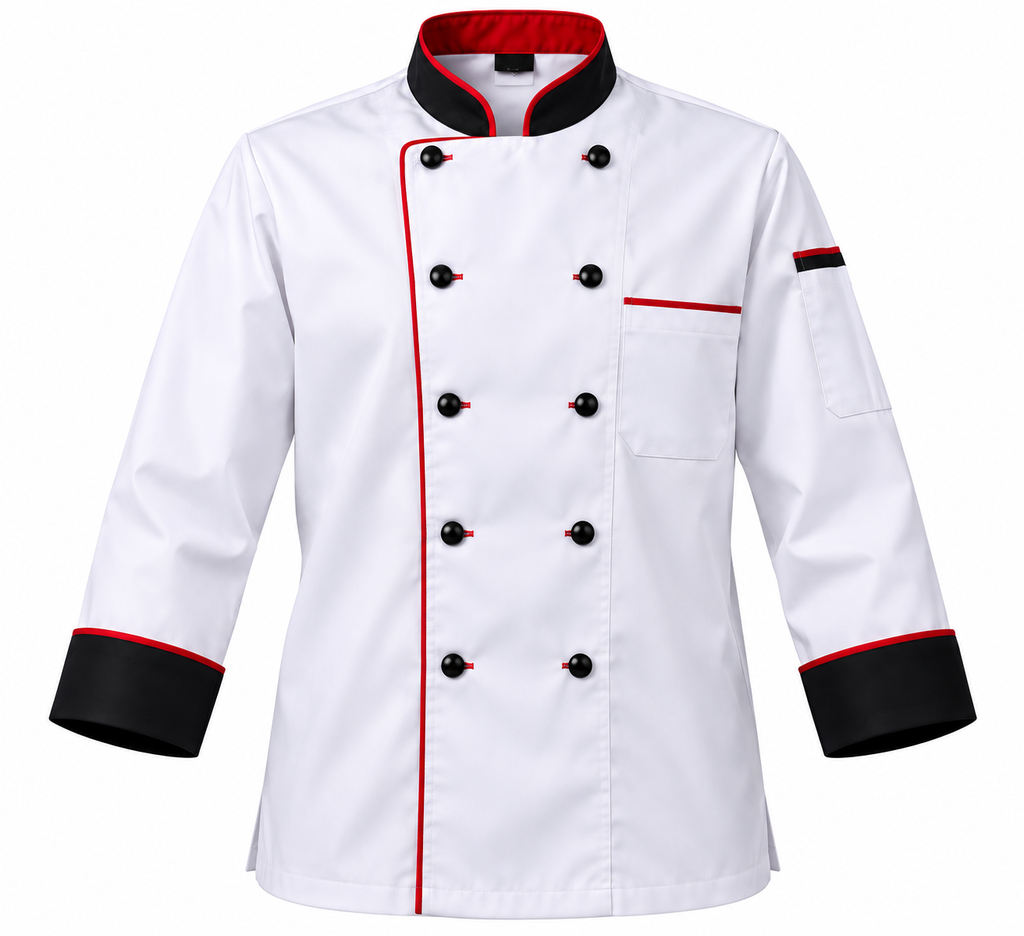
What makes a good chef coat
A chef coat isn’t just a white jacket. Every detail has a job:
- Double-breasted front: two layers of fabric shield the chest from heat and splashes. The front can also be re-buttoned to hide a stain mid-service.
- Long or three-quarter sleeves: they protect arms from hot oil and steam. Three-quarter sleeves stay clear of food and flames.
- Stud or knot buttons: they survive hot industrial washing better than plastic buttons, and can be undone quickly in an emergency.
- Breathable panels: mesh panels under the arms or across the back keep cooks cooler on long shifts.
- A thermometer or pen pocket on the sleeve, where it doesn’t catch on anything.
See our full range of chef uniforms, from classic white coats to black and charcoal styles.
Stains, colours and laundry
Oil, turmeric and gravy stains are the main reason restaurant uniforms get replaced early. Three choices make the biggest difference.
1. Choose the colour by role.
| Role | Colour that works best | Why |
|---|---|---|
| Head chef and cooks | White | Looks hygienic, and white cotton or poly-cotton can be bleached |
| Kitchen trousers and aprons | Black, charcoal or houndstooth check | Hides oil and spice stains between washes |
| Waiters | Black, white or your brand colour, with a dark apron | The apron takes the spills, so shirts stay clean |
| Helpers and dishwashers | Dark grey, navy or maroon | Looks clean for longer in a wet, greasy area |
2. Ask for a stain-release finish on chef coats and aprons. It helps oil and food stains wash out instead of setting into the fabric. Like any finish, it fades over many washes, so ask how long it lasts.
3. Wash the right way. Wash kitchen whites hot, at 60°C, to remove grease and bacteria. Wash coloured uniforms cooler, inside out, so they don’t fade. Fabric rated 4 or above for colourfastness to washing (ISO 105-C06) keeps its colour far longer.
For front-of-house staff, see our waiter uniforms: shirts, waistcoats and aprons matched to your brand colours.
One look for the whole restaurant
Guests notice when the kitchen, waiters and front desk look like one team. Plan all the uniforms together:
- Pick one colour palette. For example: white chef coats, black aprons, and black waiter shirts with a brand-colour waistcoat.
- Use the same logo everywhere. Embroider it on the chef coat chest, the waiter shirt or waistcoat, and the apron. Embroidery outlasts printing in hot washes.
- Add names on chef coats. It’s a small touch that guests and staff both notice.
- Cover hair in the kitchen. Chef caps, skull caps, ps or hairnets keep food safe, and food inspectors check for them.
How many sets does each staff member need?
We usually suggest three sets per kitchen staff member (one worn, one in the wash, one spare) and two sets per waiter. Kitchen uniforms get dirty faster and are washed hotter, so they wear out sooner.
Checklist before you order restaurant uniforms
- Cotton-rich fabric chosen for tandoor, grill and open-flame stations
- Fabric and GSM stated on the quote for every item
- Colour chosen by role (whites for cooks, dark trousers and aprons)
- Stain-release finish on chef coats and aprons, with its wash rating
- Logo position and size approved on a sample
- Sizes collected for every staff member, with a few spares
- Three sets per kitchen staff and two per waiter budgeted
Opening a new restaurant or hotel? See our hotel and restaurant uniforms, designed as one matching set for every role.
Frequently asked questions
What is the best fabric for chef coats in a hot kitchen?
A cotton-rich drill or a 65/35 poly-cotton twill at 180–220 GSM. For cooks at a tandoor, grill, or open flame, choose 100% cotton or a cotton-rich blend, because polyester can melt if it catches fire.
Why are chef coats double-breasted?
The double front gives two layers of fabric against heat and hot splashes. It can also be re-buttoned the other way to hide a stain during service.
Which colour hides stains best on restaurant uniforms?
Black, charcoal, and houndstooth check hide oil and spice stains best, so they suit kitchen trousers and aprons. White chef coats show stains but can be bleached, which keeps them looking hygienic.
What is the minimum order for restaurant uniforms?
At Saad Enterprises, bulk orders usually start from 30–50 sets per design. The exact minimum depends on the garment, fabric,c and logo method, and we confirm it on your quote.
Get a free restaurant uniform quote.
Tell us your roles (chefs, kitchen staff, waiters, front desk), the number of staff, and your brand colours. We’ll send fabric swatches, asample plana,n and a bulk price.
WhatsApp: +92 331 5050974 · Visit: our factory on IJP Road, opposite I-10, Rawalpindi · Or: use our contact page


